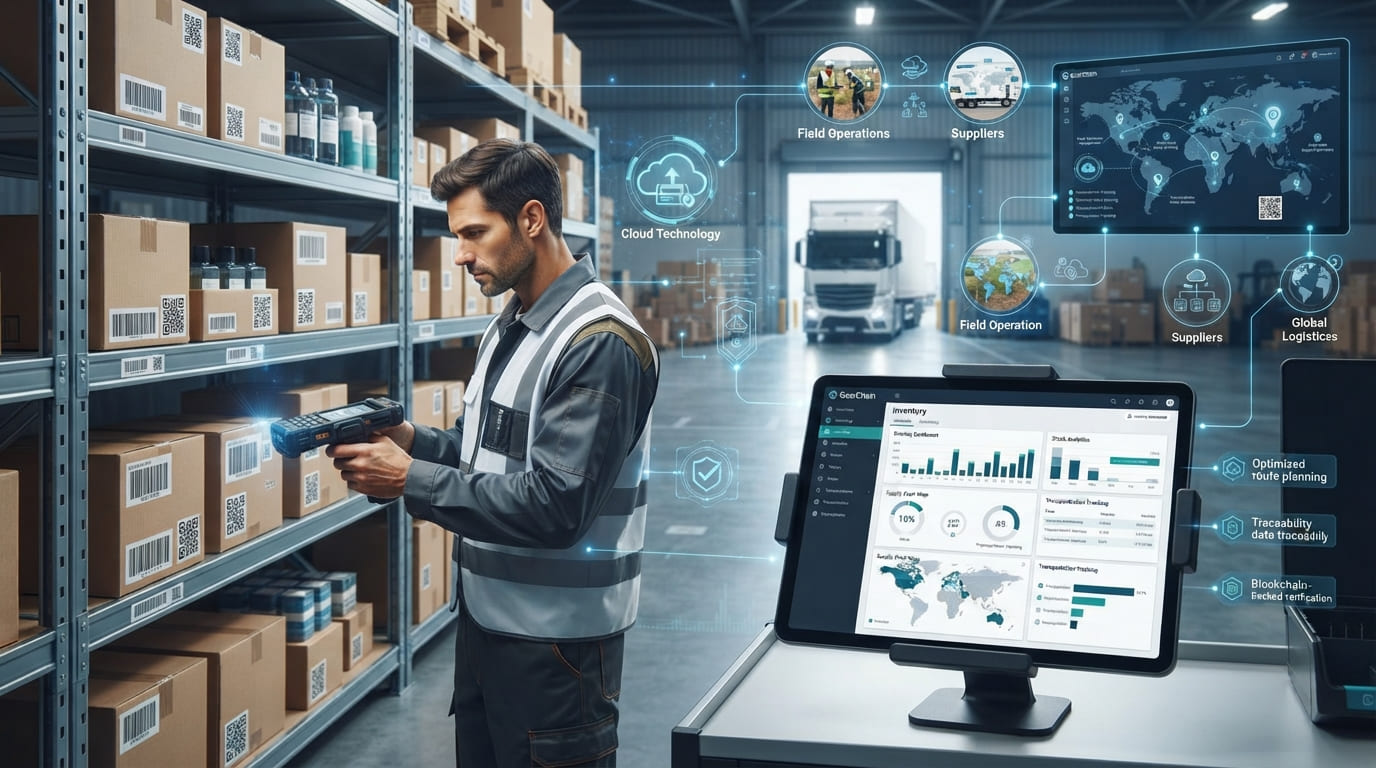
Supply chain optimization is no longer simply about moving products from suppliers to customers at the lowest possible cost. Modern businesses must manage inventory, assets, suppliers, purchasing, warehouse activity, operational data, and fulfillment while responding quickly to changing demand.
The problem is that many supply chain operations still depend on disconnected spreadsheets, manual data entry, delayed stock counts, and information stored across different systems. These gaps reduce supply chain visibility and make accurate planning difficult.
Effective supply chain management requires a connected flow of reliable data. With real-time inventory tracking, barcode scanning, structured workflows, analytics, automation, and improved traceability, organizations can make faster decisions and create more resilient supply chains.
GearChain supports this approach by helping businesses create flexible inventory, asset, and supply chain tracking workflows without requiring complex custom software. Its mobile and web-based capabilities include barcode and NFC scanning, spreadsheet synchronization, custom forms, AI-assisted setup, reporting, and optional blockchain-backed verification.
What Is Supply Chain Optimization?
Supply chain optimization is the process of improving how products, materials, information, inventory, and resources move across a supply network to increase efficiency, visibility, accuracy, and resilience while controlling costs.
Optimization affects nearly every stage of supply chain operations, including:
procurement and sourcing
inventory management
warehousing
asset tracking
supplier management
production and manufacturing
transportation and distribution
order fulfillment
demand planning
reporting and forecasting
The objective is not simply cost reduction. A well-optimized supply chain also improves inventory availability, traceability, operational efficiency, decision-making, service levels, and customer satisfaction.
Why Supply Chain Visibility Comes First
A business cannot effectively optimize what it cannot see.
Supply chain visibility means having accurate and timely information about inventory, materials, assets, orders, suppliers, locations, and operational events. When that information is delayed or fragmented, supply chain planning becomes reactive.
For example, inaccurate stock information can lead to unnecessary purchasing, stockouts, excess inventory, higher carrying costs, and slow order fulfillment.
Real-time supply chain visibility creates a more reliable foundation for decision-making.
GearChain helps teams capture operational information directly where activities happen. Workers can scan 1D or 2D barcodes, use NFC where appropriate, complete custom forms, and update records using mobile or web applications. Data can then synchronize with familiar spreadsheet workflows.
This reduces the gap between physical operations and digital records.
Improve Inventory Optimization with Real-Time Data
Inventory optimization involves maintaining enough inventory to satisfy demand without tying excessive working capital to unnecessary stock.
That balance becomes difficult when inventory data is inaccurate.
Businesses need clear information about:
current stock levels
inventory locations
incoming and outgoing quantities
raw materials
parts and components
tools and equipment
consumption patterns
replenishment requirements
Real-time inventory tracking can help reduce stockouts and overstocking while improving inventory turnover.
Barcode-based inventory management also reduces repetitive manual data entry. Instead of recording every movement later, employees can scan an item when receiving, transferring, issuing, consuming, or returning it.
Better inventory accuracy improves procurement planning, warehouse management, resource allocation, and demand forecasting.
Replace Manual Processes with Supply Chain Automation
Manual processes create unnecessary friction across supply chains.
Teams may spend significant time entering information into spreadsheets, copying records between systems, checking asset locations, reconciling inventory counts, or searching for previous transactions.
Supply chain automation reduces repetitive work by creating structured workflows for recurring operational events.
With configurable forms and tracking processes, businesses can standardize how employees record inventory movements, inspections, equipment activity, deliveries, or other supply chain events.
GearChain's no-code approach allows operational teams to configure tracking workflows without relying on a software development team for every process change.
This can improve process efficiency while reducing human error and inconsistent data capture.
Connect Warehouse and Field Operations
Supply chain data does not exist only inside a warehouse.
Construction teams move tools between sites. Manufacturers track parts and raw materials. Healthcare organizations manage equipment and supplies. Retail businesses monitor inventory across locations. Field operations need to know where assets are being used.
A connected supply chain should therefore support data capture wherever work occurs.
Mobile inventory management gives employees the ability to scan, update, and verify information at the point of activity rather than waiting to return to a desktop system.
This creates stronger inventory visibility and makes collaboration between warehouse staff, field teams, managers, suppliers, and other stakeholders more efficient.
Use Existing Spreadsheet Workflows More Effectively
Spreadsheets remain an important operational tool for many organizations.
The challenge is not necessarily using spreadsheets. The problem arises when teams depend on spreadsheets alone for physical data capture, barcode scanning, asset identification, and multi-user operational workflows.
GearChain can synchronize tracking records with Google Sheets and Excel, allowing businesses to maintain familiar data environments while adding structured mobile workflows.
Organizations can also connect with other business software through API integrations.
This approach can help reduce data silos while allowing companies to modernize supply chain processes without immediately replacing every existing system.
Strengthen Supply Chain Traceability
Traceability answers important questions:
Where did an item come from?
Where is it now?
Who handled it?
What event occurred?
When was the record created?
These questions matter in manufacturing, food supply chains, healthcare, retail, construction, equipment management, and many other industries.
Product traceability becomes much easier when individual events are captured consistently through barcode or NFC scanning.
GearChain also provides optional blockchain-backed verification for critical scan events. Important transactions can receive verifiable records that strengthen data integrity, accountability, and chain-of-custody visibility.
Blockchain does not replace good supply chain management. Its value is greater when it supports an already structured tracking process and is applied where auditability and trusted records genuinely matter.
Turn Supply Chain Data into Better Decisions
Collecting more data does not automatically create supply chain intelligence.
Information becomes valuable when businesses can use it to identify trends, evaluate performance, and anticipate operational needs.
Reports and forecasting can help teams evaluate:
inventory consumption
stock movement
asset utilization
purchasing patterns
operational trends
replenishment needs
resource requirements
Better historical and real-time data also supports more accurate demand forecasting.
AI can further assist modern supply chain management by helping structure workflows, analyze information, support forecasting, and reduce setup complexity. However, reliable AI-driven decisions still depend on accurate underlying data.
That makes consistent data capture an essential part of a data-driven supply chain.
Build Greater Supply Chain Resilience
Supply chain resilience is the ability to continue operating and adapt when conditions change.
Disruptions can come from supplier delays, demand volatility, material shortages, transportation problems, equipment issues, inaccurate inventory information, or unexpected changes in operations.
Organizations with poor visibility often discover these problems too late.
Real-time monitoring allows teams to identify exceptions earlier. Accurate inventory information can reveal potential shortages, while reliable asset tracking prevents teams from purchasing equipment simply because existing assets cannot be located.
Better information also improves contingency planning, supplier coordination, and resource allocation.
Resilience therefore depends not only on having alternative suppliers or additional stock. It depends on knowing what is happening across the operation early enough to act.
Reduce Supply Chain Costs Without Sacrificing Service
Supply chain cost reduction should focus on eliminating waste rather than simply cutting resources.
High costs can result from:
excess inventory
unnecessary purchases
stockouts
inaccurate orders
misplaced assets
manual administrative work
duplicate data entry
poor warehouse visibility
avoidable delays
inefficient resource utilization
Improved inventory accuracy and process automation can reduce many of these hidden costs.
At the same time, better visibility supports faster fulfillment and better service levels.
This creates a more sustainable form of cost optimization: improving the efficiency of the process rather than reducing the resources required to serve customers effectively.
Measure Supply Chain Performance
Continuous improvement requires measurable performance.
Useful supply chain KPIs can include inventory turnover, stockout rate, order cycle time, forecast accuracy, inventory accuracy, lead time, fulfillment rate, supplier performance, asset utilization, and on-time delivery.
The correct metrics depend on the operation.
More importantly, the underlying data must be trustworthy.
Structured forms, barcode scanning, real-time updates, and standardized workflows make operational records more consistent. That gives managers a stronger foundation for performance monitoring and data-driven decision-making.
Creating a Smarter Digital Supply Chain
Digital supply chain transformation does not always require an immediate enterprise-wide technology replacement.
For many organizations, meaningful optimization starts with smaller operational improvements:
Capture accurate data at the source.
Give employees simple mobile tools.
Replace repetitive manual entry.
Connect inventory records across teams.
Improve asset and product traceability.
Integrate existing spreadsheets and business systems.
Use reliable data for reporting and forecasting.
GearChain brings these capabilities together through configurable, no-code tracking workflows designed for inventory, assets, equipment, people, and supply chain events.
The result is a connected operational environment where physical activity creates useful digital information in real time.
The Future of Supply Chain Optimization
Supply chain optimization increasingly depends on accurate data, automation, integration, analytics, artificial intelligence, mobile technology, and traceability.
But technology itself is not the objective.
The objective is a supply chain that is easier to understand, faster to operate, more resilient to disruption, and capable of making informed decisions with less manual effort.
Organizations that improve real-time supply chain visibility can better control inventory, coordinate operations, reduce unnecessary costs, strengthen traceability, and respond more quickly when conditions change.
For businesses still managing important supply chain activities through fragmented spreadsheets or manual processes, creating a connected tracking system is a practical first step toward a smarter digital supply chain.
Frequently Asked Questions
What is supply chain optimization?
Supply chain optimization is the process of improving planning, inventory, procurement, warehousing, transportation, and fulfillment so products and information move efficiently. It uses accurate data, automation, forecasting, and real-time visibility to reduce costs, prevent delays, improve service levels, and strengthen operational resilience.
How can supply chain management be improved?
Supply chain management can be improved by increasing real-time visibility, standardizing data capture, automating repetitive workflows, improving inventory accuracy, monitoring supplier performance, and using forecasting. Integrating warehouse, field, and spreadsheet data also helps teams make faster decisions and respond to disruptions earlier.
What are the benefits of supply chain optimization?
The main benefits of supply chain optimization include lower operating costs, better inventory control, shorter lead times, fewer stockouts, improved supplier coordination, faster order fulfillment, and stronger customer service. It also gives businesses better data for planning, forecasting, risk management, and continuous improvement.
What is supply chain visibility?
Supply chain visibility means having accurate, timely information about inventory, assets, orders, shipments, suppliers, and operational events across the supply network. Better visibility helps businesses identify bottlenecks, verify product movement, reduce uncertainty, improve traceability, and make faster decisions when conditions change.
How does technology improve supply chain management?
Technology improves supply chain management by connecting data, automating manual processes, and making operational information available in real time. Barcode scanning, NFC, cloud systems, APIs, analytics, AI-assisted workflows, and blockchain-backed records can improve accuracy, traceability, collaboration, forecasting, and decision-making across operations.
How can businesses reduce supply chain costs?
Businesses can reduce supply chain costs by improving inventory accuracy, avoiding excess stock, preventing stockouts, shortening manual workflows, optimizing procurement, and reducing data errors. Real-time tracking and better forecasting also help teams use labor, storage, transportation, and working capital more efficiently.