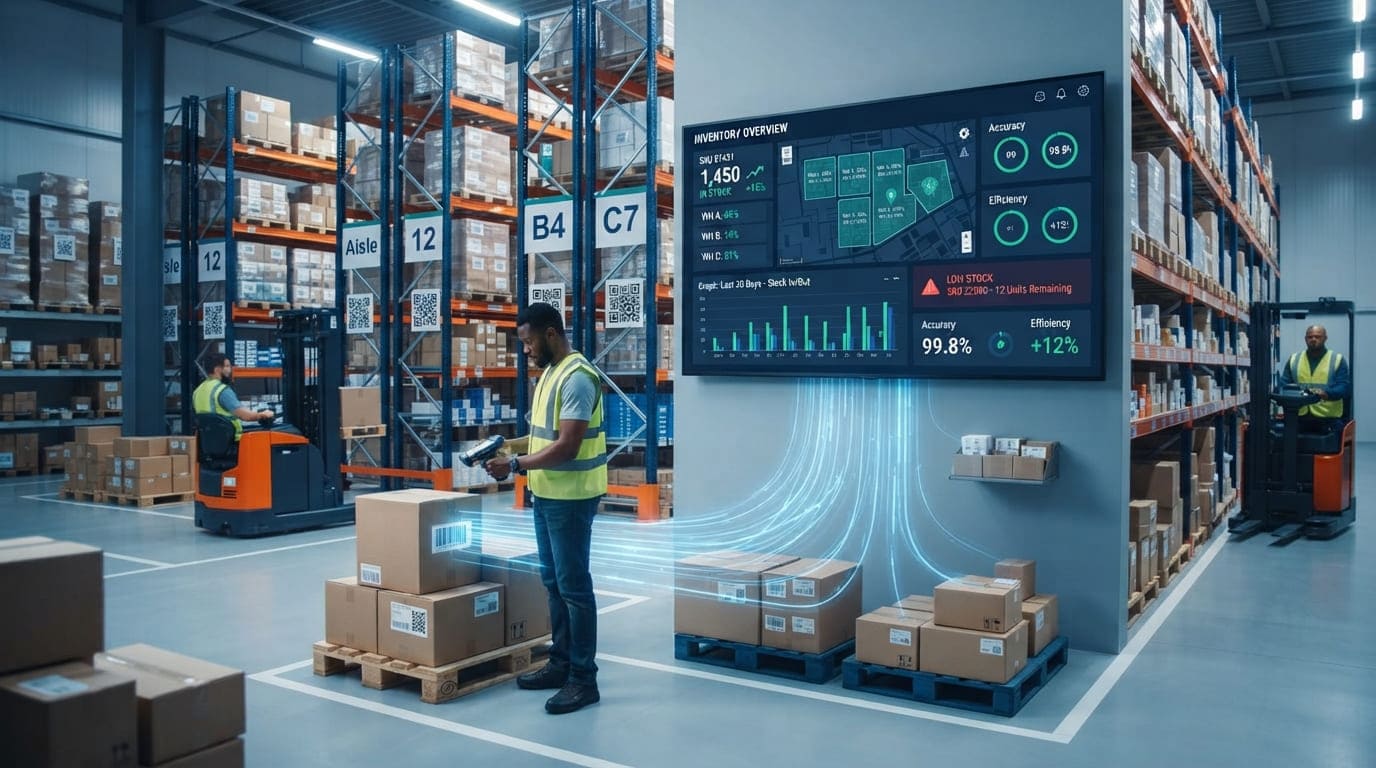
Inventory control becomes increasingly difficult as a business adds products, warehouses, suppliers, sales channels, and employees. Manual stock counts and disconnected spreadsheets may work at a small scale, but they can quickly create inventory discrepancies, delayed replenishment, excess stock, and unexpected shortages.
Advanced inventory software helps businesses control stock by providing real-time inventory tracking, automated workflows, barcode scanning, centralized inventory visibility, reporting, and forecasting. Instead of relying on outdated stock records, teams can see what inventory they have, where it is located, how it is moving, and when it may need to be replenished.
Modern inventory management software therefore goes beyond recording quantities. It creates a connected inventory control system that supports faster decisions, greater inventory accuracy, better planning, and more efficient operations.
What Is Advanced Inventory Software?
Advanced inventory software is a digital system used to track, organize, monitor, and control inventory throughout its lifecycle. It can provide a centralized view of on-hand inventory, stock movement, inventory locations, incoming materials, work-in-progress inventory, and finished goods.
Unlike basic spreadsheet inventory management, an advanced inventory management system can update inventory records as transactions occur. Barcode and QR code scanning can further reduce repetitive manual data entry and help maintain accurate stock records.
Depending on the operation, businesses can use inventory tracking software to manage:
Raw materials and components
Work-in-progress inventory
Finished goods
SKUs and product variations
Warehouse stock
Multi-location inventory
Stock transfers
Purchase and replenishment activity
Inventory transactions and adjustments
For manufacturers in particular, maintaining visibility from raw materials through finished goods can help prevent missing components from disrupting production. GearChain's inventory management solution, for example, is designed to provide real-time tracking across these stages of manufacturing.
Why Is Inventory Control Important?
Effective inventory control is about maintaining enough stock to meet demand without holding unnecessary inventory.
When stock levels are inaccurate, businesses may purchase products they already have, discover shortages too late, or leave slow-moving inventory sitting in storage. Overstocking can increase carrying and storage costs, while stockouts can lead to delayed production, unfulfilled orders, and lost sales.
Better inventory control provides a reliable foundation for inventory planning, purchasing decisions, order fulfillment, warehouse operations, and demand forecasting.
The goal is not simply to hold more inventory. It is to maintain optimal inventory levels based on actual demand, stock availability, lead times, and operational requirements.
How Advanced Inventory Software Improves Inventory Control
1. Real-Time Inventory Tracking Improves Stock Visibility
Real-time inventory tracking gives teams an up-to-date picture of stock availability.
Instead of waiting for a physical inventory count or manually consolidating multiple spreadsheets, employees can check current quantities and inventory movement through a centralized inventory dashboard.
This creates real-time inventory visibility across warehouses, stockrooms, production areas, or stores. Multi-location inventory management becomes especially valuable when inventory needs to move between facilities.
For example, a business may discover that one warehouse has excess inventory while another is approaching a stockout. Better stock visibility allows the company to consider a stock transfer before purchasing additional inventory.
GearChain supports inventory movement and visibility across multiple warehouses and locations from a centralized system.
2. Barcode Scanning Reduces Manual Inventory Errors
Manual inventory data entry introduces opportunities for human error. A mistyped SKU, incorrect quantity, or delayed spreadsheet update can cause inventory records to differ from physical stock.
A barcode inventory system simplifies data capture.
Employees can scan a barcode or QR code when inventory is received, moved, consumed, counted, or dispatched. The associated inventory transaction can then be recorded immediately rather than written down and entered later.
Barcode inventory tracking can support:
SKU tracking
Product identification
Stock counts
Inventory transfers
Receiving
Picking and fulfillment
Inventory reconciliation
Item movement history
GearChain supports mobile barcode and QR code scanning, barcode label printing, and real-time inventory updates, helping businesses reduce repetitive manual tracking.
3. Inventory Automation Creates More Efficient Workflows
Inventory automation software can reduce the repetitive tasks involved in stock management.
Rather than continuously checking every SKU manually, businesses can establish inventory thresholds and workflows that highlight items requiring attention.
Low-stock alerts, reorder points, and inventory notifications help employees identify potential shortages earlier. A reorder point represents the inventory level at which replenishment should be considered, often taking expected demand, safety stock, and supplier lead time into account.
More advanced inventory workflows can support:
Low-stock alerts
Reorder planning
Inventory replenishment
Purchase planning
Stock transfer workflows
Inventory notifications
Inventory adjustments
Inventory reporting
Automated inventory management allows employees to spend less time checking records and more time responding to meaningful inventory signals.
4. Better Inventory Accuracy Helps Prevent Stockouts and Overstocking
Two common inventory problems are stockouts and excess inventory.
A stockout occurs when demand exceeds available stock. Overstocking occurs when a business holds more inventory than it reasonably needs. Both can affect profitability.
Advanced stock control software helps businesses maintain accurate inventory data and understand current stock availability. When that information is combined with reorder levels, sales velocity, historical data, and demand patterns, teams can make better replenishment decisions.
The result is a more balanced inventory strategy: enough safety stock to protect operations without unnecessarily increasing inventory carrying costs.
For retailers, real-time visibility and low-stock alerts can also help identify shortages before shelves are empty.
Demand Forecasting and Inventory Optimization
Historical sales alone cannot guarantee future demand, but analyzing previous inventory activity can reveal useful patterns.
Demand forecasting software and inventory analytics can evaluate sales trends, consumption patterns, seasonality, inventory movement, and historical demand. Businesses can use these insights to estimate future inventory requirements and improve purchase planning.
This supports inventory optimization by answering questions such as:
Which SKUs are moving fastest?
Which products are becoming slow-moving inventory?
When could stock fall below a safe level?
Which locations hold excess inventory?
How much safety stock may be required?
When should replenishment begin?
Forecasting becomes particularly useful when businesses manage large product catalogs, variable lead times, seasonal demand, or multiple locations.
GearChain provides reporting and forecasting capabilities designed to turn tracking data into trends, forecasts, and operational insights.
Centralized Inventory Management Across Multiple Locations
Managing one stockroom is different from controlling inventory across several warehouses, stores, production facilities, or project sites.
A multi-location inventory management system provides a consolidated view while still allowing teams to monitor individual locations. Employees can identify where an item is stored, compare quantities, review stock movement, and coordinate warehouse transfers.
Centralized inventory management can therefore improve inventory allocation, stock visibility, warehouse efficiency, and inventory traceability.
It also supports business growth. New locations, products, users, and workflows can be added without creating another disconnected inventory tracking process.
Inventory Reporting Supports Data-Driven Decisions
Reliable inventory data becomes significantly more useful when it is converted into actionable reports.
Inventory reporting and analytics can help businesses monitor:
Inventory turnover
Stock availability
Inventory aging
Inventory discrepancies
Fast- and slow-moving stock
Stock movement history
Inventory adjustments
Inventory accuracy
Product demand
Location-level inventory
Replenishment requirements
These inventory performance metrics and KPIs help teams understand not only what is currently in stock but also how efficiently inventory is being managed.
For more detailed inventory control, businesses may also use techniques such as ABC analysis, cycle counting, economic order quantity (EOQ), safety stock calculations, inventory turnover ratios, and inventory aging analysis.
Integrating Inventory Software With Existing Workflows
Replacing every existing business system is not always necessary.
Modern cloud-based inventory software can work alongside spreadsheets, accounting systems, enterprise resource planning systems, procurement processes, e-commerce channels, and other operational tools.
GearChain, for example, supports synchronization with Google Sheets and Microsoft Excel while providing connections to other business software through integrations and APIs.
This approach can help businesses move beyond manual spreadsheet inventory management without immediately abandoning familiar data workflows.
The important objective is to establish a reliable source of inventory data so that employees are not making purchasing or fulfillment decisions from conflicting records.
Choosing the Right Inventory Control Software
The best inventory control software should match the way inventory actually moves through the business.
Before selecting an inventory management solution, consider whether the system supports real-time stock tracking, barcode scanning, mobile inventory management, multi-location tracking, inventory reports, configurable workflows, forecasting, integrations, user permissions, and scalability.
Ease of use matters as well. An advanced system provides limited value when warehouse or operations teams find it too complicated to update consistently.
GearChain combines no-code tracking workflows with barcode and NFC scanning, configurable fields, mobile and web access, reporting, forecasting, spreadsheet synchronization, and multi-location support. This makes it relevant for businesses seeking to improve inventory visibility without introducing unnecessary complexity into everyday inventory operations.
Building Smarter Inventory Control
Advanced inventory software turns inventory control from a reactive process into a more proactive one.
Instead of discovering shortages during fulfillment, teams can monitor stock levels earlier. Instead of relying entirely on physical counts, they can capture inventory movement as it happens. Instead of purchasing based on assumptions, they can use inventory analytics and historical data to support planning.
The combination of real-time inventory management, barcode scanning, inventory automation, demand forecasting, multi-location visibility, centralized reporting, and data synchronization creates a stronger foundation for inventory optimization.
For growing businesses, that can mean fewer inventory discrepancies, better product availability, reduced manual work, improved warehouse productivity, more efficient replenishment, and better control over working capital.
Ultimately, effective inventory management is not about tracking more data. It is about turning accurate inventory data into better operational decisions.
FAQs
What is inventory management software?
Inventory management software is a digital system that helps businesses track stock levels, locations, movements, and inventory transactions. It improves inventory visibility, reduces manual data entry, supports replenishment planning, and provides more accurate information for purchasing, warehouse operations, and order fulfillment.
What is inventory control software?
Inventory control software helps businesses monitor and regulate stock throughout its lifecycle. It tracks quantities, locations, inventory movement, and stock availability while supporting processes such as barcode scanning, cycle counting, reorder planning, replenishment, inventory reconciliation, and multi-location stock management.
How does inventory management software work?
Inventory management software records inventory transactions as products are received, moved, consumed, counted, or shipped. Modern systems combine real-time tracking, barcode scanning, centralized databases, inventory alerts, reports, and forecasting tools to maintain accurate stock records and improve operational decisions.
What are the benefits of inventory management software?
Inventory management software can improve stock accuracy, increase inventory visibility, reduce manual errors, prevent stockouts, control excess inventory, streamline replenishment, and improve order fulfillment. Reporting and forecasting features also help businesses make better purchasing, warehouse, and inventory planning decisions.
How can inventory software reduce stockouts?
Inventory software reduces stockouts by monitoring current stock levels and identifying products approaching minimum thresholds or reorder points. Real-time inventory data, low-stock alerts, demand forecasting, safety stock planning, and replenishment workflows help teams respond before available inventory reaches critical levels.
How do you choose the best inventory management software?
Choose inventory management software based on your operational requirements, inventory volume, locations, and workflows. Look for real-time tracking, barcode scanning, multi-location management, reporting, forecasting, mobile access, integrations, configurable permissions, scalability, and an interface employees can use consistently.