Understanding Inventory Accounting: Key Principles and Practices
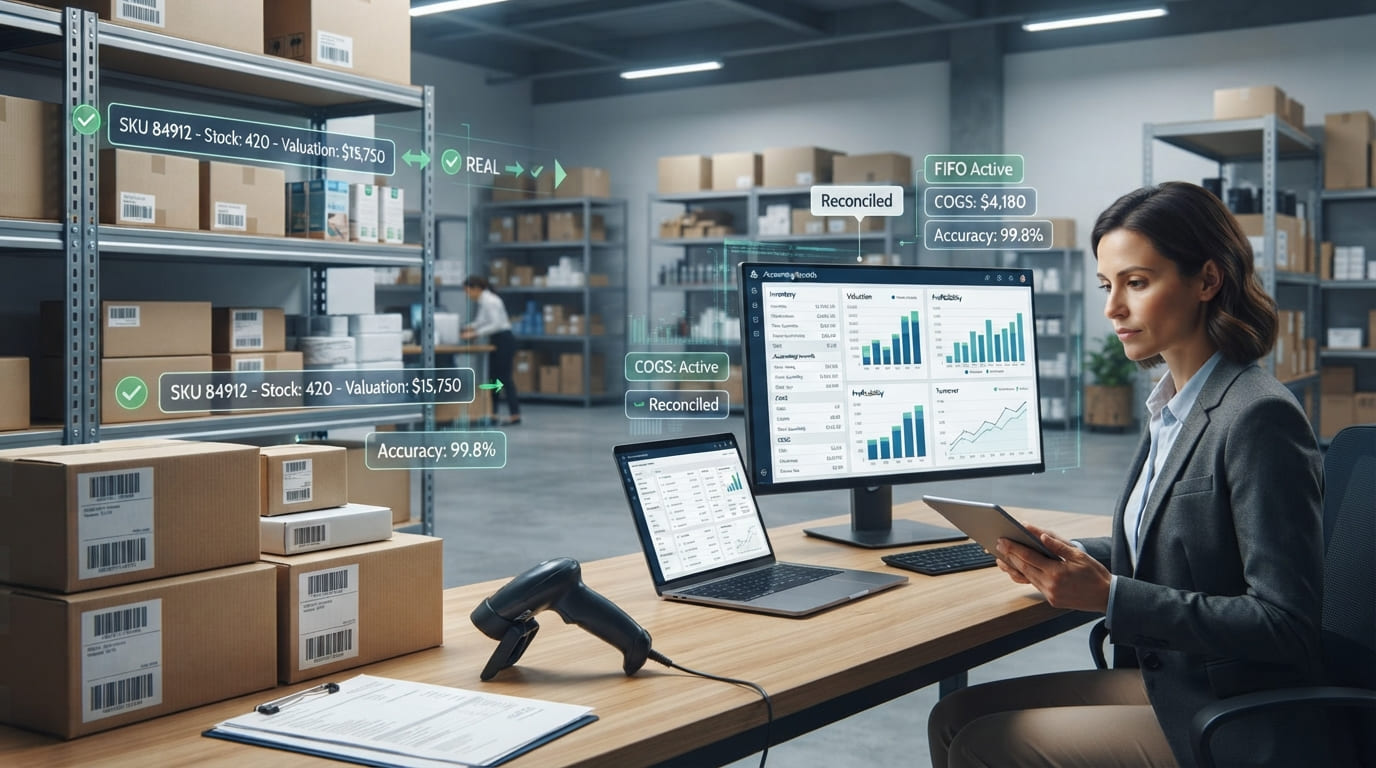
Inventory accounting is the process of recording, valuing, and reporting goods a business owns for resale or production. It connects physical stock movement with financial reporting by showing what inventory is worth, what has been sold, and how much cost should move into cost of goods sold (COGS).
For retailers, distributors, and manufacturers, accurate inventory accounting supports reliable balance sheets, income statements, gross profit calculations, purchasing decisions, and cash-flow planning. It also depends on accurate operational records: incorrect quantities or stock movements can eventually create inaccurate accounting data.
What Is Inventory Accounting?
Inventory is generally treated as a current asset while a business owns goods held for sale or used in production. When inventory is sold, its assigned cost moves from the inventory asset account to COGS, affecting gross profit and net income.
A basic COGS formula is:
Beginning Inventory + Purchases − Ending Inventory = Cost of Goods Sold
Inventory accounting therefore answers three important questions: How much inventory does the business have? What is that inventory worth? What cost should be recognized when goods are sold?
Main Types of Inventory
Businesses commonly classify inventory according to where goods sit in the operating cycle.
Raw materials are components used to make products. Work in process (WIP) covers partially completed goods. Finished goods are completed products ready for sale. Retail businesses also commonly hold merchandise inventory, or products purchased for resale.
Correct classification helps businesses understand purchase cost, production cost, direct materials, direct labor, manufacturing overhead, and ending inventory. For manufacturers, accurately tracking movement from raw materials through WIP to finished goods is especially important.
Key Inventory Valuation Methods
Inventory valuation determines which costs remain in ending inventory and which become COGS. The main inventory costing methods include FIFO, LIFO, weighted average cost, and specific identification.
Under IFRS, IAS 2 permits specific identification for inventory items that are not ordinarily interchangeable and FIFO or weighted average cost for ordinarily interchangeable inventory. LIFO is not permitted under IFRS. U.S. GAAP recognizes cost-flow assumptions including FIFO, average cost, and LIFO.
The inventory accounting method selected can affect COGS, ending inventory, gross profit, net income, working capital, and tax calculations, particularly when purchase prices change.
Periodic vs. Perpetual Inventory Systems
A periodic inventory system updates inventory balances at defined intervals. A physical inventory count is commonly used at the end of an accounting period to establish ending inventory and calculate COGS.
A perpetual inventory system updates inventory records as purchases, sales, transfers, or consumption occur. This provides more timely stock information, although physical counts and cycle counting remain necessary for detecting shrinkage, damage, missing items, and recording errors.
Barcode scanning and real-time inventory tracking can improve the source data used for inventory reconciliation and financial reporting.
How Inventory Is Recorded in Accounting
Under a typical perpetual system, purchasing inventory generally increases the inventory asset account:
Debit: Inventory
Credit: Cash or Accounts Payable
When inventory is sold, its assigned cost moves to COGS:
Debit: Cost of Goods Sold
Credit: Inventory
Sales revenue is recorded separately. Actual inventory journal entries vary according to the transaction, accounting system, taxes, returns, and freight treatment. Businesses should reconcile supplier invoices, receiving records, inventory ledgers, and physical quantities so operational records agree with the general ledger.
What Costs Can Be Included in Inventory?
Inventory cost can involve more than the supplier's purchase price. Depending on the accounting framework and circumstances, it may include purchase costs, freight-in, import duties, handling, conversion costs, direct labor, and allocated manufacturing overhead required to bring inventory to its present location and condition.
This makes landed cost and cost allocation important. Missing or incorrectly allocated costs can distort inventory value, COGS, and gross margin.
Inventory should also not remain overstated when its economic value declines. IAS 2 requires inventories to be measured at the lower of cost and net realizable value (NRV). NRV considers the estimated selling price less estimated costs necessary to complete and sell the inventory.
Shrinkage, Obsolescence, and Inventory Adjustments
Inventory records can differ from physical stock because of theft, damage, spoilage, misplaced products, counting errors, or unrecorded transactions. These differences may require inventory adjustments, write-downs, or write-offs.
Obsolete inventory and slow-moving inventory deserve particular attention because inventory carrying values can become overstated when goods can no longer recover their recorded cost.
Physical inventory counts, cycle counting, inventory reconciliation, variance reviews, and an audit trail help detect discrepancies and improve the reliability of inventory records.
Inventory Accounting Best Practices
Use a consistent inventory valuation method. Apply the selected inventory cost method according to the relevant accounting framework and accounting policy.
Maintain accurate inventory records. Record receipts, transfers, production, consumption, and sales promptly.
Perform physical counts and cycle counts. Compare actual quantities with recorded inventory balances and investigate inventory variance.
Review obsolete and damaged inventory. Determine whether stock requires an inventory write-down or write-off.
Reconcile inventory with accounting records. Compare operational data with the inventory account, general ledger, purchases, and COGS.
Monitor inventory performance. Inventory turnover, stock accuracy, gross margin, and days inventory outstanding can highlight slow-moving inventory and working-capital pressure.
Strengthen internal controls. Standardized workflows, approvals, access controls, and traceable records improve inventory accuracy.
How Better Inventory Tracking Supports Accounting Accuracy
Inventory accounting is only as dependable as the quantity and movement data supporting it. That makes inventory tracking, barcode workflows, structured data capture, and reconciliation relevant to finance teams as well as warehouse and operations teams.
GearChain is designed for operational inventory tracking, rather than as a replacement for an accounting ledger. Its workflows can track raw materials, work in process, finished goods, quantities, locations, and stock movements. Barcode-based updates can reduce manual data entry, while spreadsheet synchronization and reporting can support cleaner operational records for downstream reconciliation.
For manufacturing operations, GearChain supports real-time inventory visibility across stages ranging from raw materials through finished goods. Better source data can make physical counts, inventory reconciliation, variance investigation, and period-end processes easier to manage.
Final Takeaway
Understanding inventory accounting means understanding the relationship between physical stock, inventory valuation, COGS, financial statements, inventory controls, and reliable operating data. Businesses that classify inventory correctly, use consistent costing methods, reconcile records, monitor shrinkage and obsolescence, and maintain accurate transaction data are better positioned to produce reliable financial information and make stronger operational decisions.
Frequently Asked Questions About Inventory Accounting
What is inventory accounting?
Inventory accounting is the process of recording, valuing, and reporting goods a business owns for sale or production. It matters because inventory values affect cost of goods sold, gross profit, current assets, taxable income, cash-flow analysis, and the accuracy of financial statements.
What are the 4 types of inventory?
Common business guides often group inventory into raw materials, work in process, finished goods, and maintenance, repair, and operations supplies. Retailers may instead focus on merchandise inventory. The exact accounting classification depends on what the business owns and how items are used.
How do you record inventory in accounting?
When inventory is purchased under a perpetual system, businesses generally debit Inventory and credit Cash or Accounts Payable. When goods are sold, their cost moves from Inventory to Cost of Goods Sold, while sales revenue is recorded separately in the accounting records.
What are the main inventory accounting methods?
The main inventory costing methods are FIFO, LIFO, weighted average cost, and specific identification. FIFO assigns older costs first, LIFO assigns newer costs first, weighted average smooths unit costs, and specific identification traces the actual cost of individually identifiable inventory items.
What is the difference between FIFO and LIFO inventory accounting?
FIFO assumes the oldest inventory costs are assigned to cost of goods sold first, while LIFO assigns the newest costs first. During rising prices, the methods can produce different COGS, ending inventory, gross profit, and tax results. IFRS does not permit LIFO.
What is the difference between periodic and perpetual inventory systems?
A periodic inventory system updates inventory balances at defined intervals, usually after a physical count. A perpetual inventory system updates quantities and costs as transactions occur. Perpetual records provide more timely visibility, but businesses still need physical counts and reconciliation to identify discrepancies.

Enter email to get Free Google Sheets Template
We’ll email you a quick verification link. Click it to confirm your address and your template will open automatically.
Enter email to get Free Excel Template
We’ll email you a quick verification link. Click it to confirm your address and your template will open automatically.