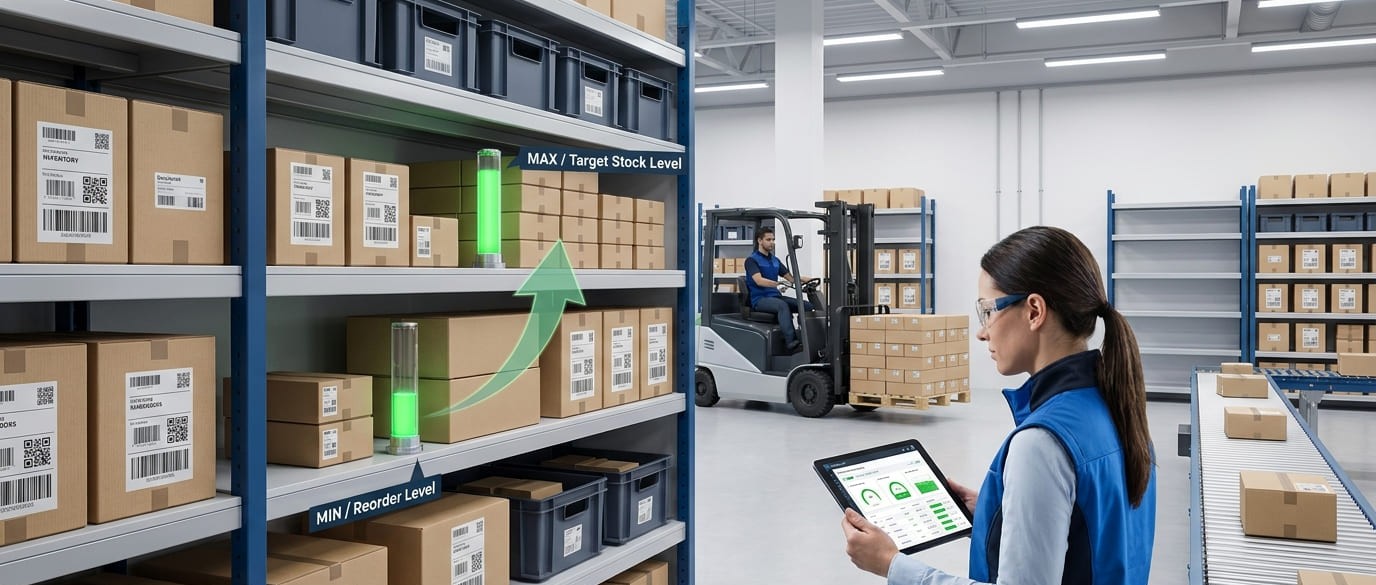
Keeping too little stock can lead to shortages, delayed orders, and missed sales. Keeping too much can tie up cash, fill storage space, and leave a business with slow-moving inventory.
A Min-Max inventory system provides a simple way to balance these risks.
The method gives each inventory item two important stock levels:
Minimum stock level: the point at which replenishment should begin.
Maximum stock level: the target inventory level after replenishment.
When inventory reaches the minimum level, you reorder enough stock to move inventory back toward the maximum level.
The concept is simple, but effective Min-Max inventory management depends on accurate stock data, realistic supplier lead times, changing demand, and regular reviews of each SKU.
What Is Min-Max Inventory?
Min-Max inventory is a stock-control method that uses minimum and maximum inventory levels to guide replenishment.
The minimum acts as a reorder trigger. When available inventory falls to or below this threshold, the business knows it is time to replenish.
The maximum acts as a replenishment target. It represents approximately how much stock the business wants available after new inventory arrives.
The basic workflow is:
Monitor stock → Reach Min → Reorder → Replenish toward Max → Continue monitoring
This gives inventory teams a consistent process instead of deciding when and how much to order based on guesswork.
What Is a Minimum Stock Level?
The minimum stock level is the lower inventory threshold that signals that an item needs replenishment.
In a Min-Max inventory system, the minimum generally functions as the reorder point.
It should be high enough to cover expected demand while waiting for replacement stock to arrive. Businesses may also include safety stock to protect against supplier delays or unexpected increases in demand.
For example, a business may set a minimum stock level of 60 units for a particular SKU. When available inventory reaches 60, the purchasing team knows that replenishment should begin.
Setting the Min too low increases the risk of stockouts. Setting it unnecessarily high can cause orders to be placed earlier than needed.
What Is a Maximum Stock Level?
The maximum stock level is the target quantity you want inventory to return toward after replenishment.
It is not necessarily a strict ceiling that stock can never exceed.
Supplier case packs, minimum order quantities, large inbound shipments, returns, or changing demand can occasionally push physical inventory above the target.
The purpose of the Max level is to prevent businesses from continually ordering more than they reasonably need.
A useful maximum stock level should consider:
expected demand
purchasing frequency
storage capacity
supplier requirements
product value
carrying costs
seasonal demand
available working capital
The goal is to maintain enough stock for operations without creating unnecessary excess inventory.
How Does a Min-Max Inventory System Work?
Suppose an item has:
Minimum level: 50 units
Maximum level: 150 units
When available inventory reaches 50 units, the Min threshold triggers replenishment.
If no additional inventory is already coming, the business may order enough to move the stock position toward 150 units.
In this simple example, that could mean ordering approximately 100 units.
The calculation itself is not the most difficult part.
The challenge is ensuring that the 50-unit stock figure is accurate, the supplier can deliver on time, incoming purchase orders have been considered, and current demand still supports the Min and Max values.
That is why Min-Max inventory should be treated as an ongoing inventory process rather than a one-time calculation.
How to Set a Minimum Inventory Level
There is no single minimum stock quantity that works for every product.
Start with the factors that determine how much stock you need before another delivery can arrive.
Review Average Demand
Look at how quickly the SKU is normally sold, consumed, issued, or used.
A fast-moving item usually needs a different minimum threshold than a product that moves only occasionally.
Historical sales and inventory usage can help identify normal demand, but recent changes should also be considered.
Check Supplier Lead Time
Supplier lead time is the period between starting replenishment and having replacement inventory available.
Longer lead times normally require an earlier reorder trigger because your existing stock needs to cover demand for a longer period.
Do not rely only on a supplier's ideal shipping estimate. Actual lead time can include order processing, preparation, transportation, receiving, and other delays.
Add Safety Stock Where Needed
Safety stock is additional inventory maintained as a buffer.
It can help protect against:
unexpected demand
supplier delays
demand variability
transportation disruptions
larger-than-normal customer orders
Items with stable demand and highly reliable suppliers may require smaller buffers. Items with unpredictable demand or inconsistent lead times may need more protection.
In simple terms:
Expected demand during lead time + appropriate safety stock = a practical Min threshold
The article does not need to become a statistics exercise. What matters operationally is whether the Min gives the business enough time to replenish before stock runs out.
How to Set a Maximum Inventory Level
Once the minimum is established, decide how much inventory you reasonably want after replenishment.
The Max should cover expected needs until the next purchasing cycle without creating unnecessary overstock.
Consider:
Purchasing Frequency
A business that orders every week may need a different maximum level than one that orders only once a month.
Storage Capacity
There is little benefit in setting a maximum quantity that creates warehouse, shelf, or stockroom problems.
Supplier Requirements
Suppliers may have minimum order quantities, case packs, carton sizes, or fixed ordering multiples.
Your ideal replenishment quantity may therefore need adjusting to match how the supplier actually sells the product.
Inventory Cost
High-value items can tie up considerable working capital when maximum levels are set too high.
Lower-value essential supplies may justify larger buffers if running out would disrupt operations.
Why Inventory Position Matters
A common Min-Max inventory mistake is looking only at what is physically on the shelf.
Suppose your Min level is 100 units and you currently have 90 units on hand.
At first glance, that appears to require another order.
But what if 150 units are already on the way from your supplier?
Placing another purchase order without considering incoming inventory could create unnecessary overstock.
This is why replenishment decisions should consider inventory position, which can include:
inventory on hand
inventory already on order
committed or allocated inventory
backorders
expected incoming stock
Min-Max inventory becomes more reliable when businesses understand the stock available now as well as inventory already moving through the replenishment process.
How Min-Max Inventory Helps Prevent Stockouts
The Min threshold gives businesses an earlier warning that stock is approaching a risky level.
Rather than discovering a shortage after the last item has been sold or used, teams can begin replenishment while inventory is still available.
This is particularly useful for frequently used materials, supplies, replacement parts, and fast-moving products.
However, simply creating a Min number does not prevent stockouts.
The underlying inventory record also needs to be accurate.
If the system says 70 units are available but only 40 physically exist, replenishment may begin too late.
How Maximum Stock Levels Help Control Overstock
Maximum stock levels address the opposite inventory problem.
Without a target, teams may order larger quantities simply because they seem safer or because suppliers offer volume discounts.
That can create:
excess inventory
higher carrying costs
limited storage space
slow-moving stock
obsolete products
unnecessary cash tied up in inventory
A Max level provides a practical target for replenishment instead of allowing purchasing quantities to grow without clear limits.
When Should You Update Min-Max Levels?
Min and Max inventory levels should not remain unchanged forever.
Review them when there are meaningful changes in:
sales velocity
inventory usage
supplier lead time
seasonal demand
supplier reliability
purchase frequency
storage capacity
product lifecycle
business growth
A SKU that sold slowly six months ago may now move quickly. A supplier that once delivered within three days may now take ten.
If the conditions change but the thresholds remain the same, the Min-Max system becomes less useful.
For seasonal products, businesses may need different stock levels during peak and slower periods.
Common Min-Max Inventory Mistakes
One of the biggest mistakes is setting Min and Max levels once and forgetting about them.
Other common problems include:
using the same thresholds for every SKU
setting levels based on guesses
ignoring safety stock
using outdated demand data
overlooking supplier delays
ignoring incoming purchase orders
failing to consider committed inventory
setting the Max unnecessarily high
setting the Min too low
ignoring seasonality
relying on inaccurate stock counts
Each SKU can have different demand, value, lead time, supply risk, and replenishment requirements.
Min-Max levels should reflect those differences.
Using Real-Time Inventory Tracking With Min-Max Levels
A Min-Max system becomes more useful when current stock quantities are easy to see and update.
GearChain supports current-stock fields with configurable thresholds for restocking alerts, allowing teams to connect stock monitoring with everyday inventory activity. It also supports barcode and QR scanning, mobile stock updates, multiple locations, and real-time synchronization with Google Sheets and Excel.
For example, teams can record inventory movements as products are received, transferred, issued, adjusted, or shipped. More current inventory records make it easier to recognize when a SKU is approaching its Min level.
This matters because even well-planned stock thresholds cannot compensate for inaccurate inventory data.
The purpose of technology is not to make Min-Max planning more complicated. It is to make the information behind replenishment decisions more reliable.
Final Thoughts
Min-Max inventory gives businesses a practical way to control stock using two clear thresholds.
The Min level tells you when replenishment should begin.
The Max level tells you approximately how far inventory should be replenished.
Effective Min-Max inventory management depends on more than choosing two numbers. Businesses should consider demand, supplier lead times, safety stock, purchasing frequency, incoming inventory, storage limits, and SKU-level differences.
Most importantly, review the levels regularly.
When accurate inventory tracking is combined with realistic Min and Max thresholds, businesses can make replenishment decisions earlier, reduce stockout risk, limit unnecessary overstock, and maintain more appropriate inventory levels.
FAQs
What is min max inventory?
Min-max inventory is a replenishment method that assigns each item a minimum and maximum stock level. When inventory reaches the minimum threshold, replenishment begins, with the goal of bringing stock back toward the predetermined maximum level.
How do you calculate minimum and maximum inventory levels?
Set the minimum level using expected demand during supplier lead time plus appropriate safety stock. Set the maximum high enough to cover demand through the next replenishment cycle while considering purchasing frequency, storage capacity, supplier restrictions, and inventory cost.
What is the minimum stock level in inventory?
The minimum stock level is the lower inventory threshold that signals when replenishment should begin. In a min-max system, it usually acts as the reorder trigger and should provide enough stock to cover demand while replacement inventory is arriving.
What is the maximum stock level in inventory?
The maximum stock level is the target quantity an item should reach after replenishment. It helps prevent unnecessary overstock by giving purchasing teams an upper inventory target based on demand, purchasing cycles, storage limits, supplier requirements, and inventory cost.
What is the difference between minimum stock and safety stock?
Minimum stock is the threshold that normally triggers replenishment in a min-max system. Safety stock is additional inventory kept as protection against unexpected demand or delayed deliveries. Safety stock can therefore be one factor used when establishing the minimum level.
How often should min-max inventory levels be updated?
Review min-max inventory levels whenever demand, supplier lead time, seasonality, purchasing frequency, or supplier reliability changes. Fast-moving or seasonal SKUs may need more frequent reviews because outdated thresholds can increase the risk of either stockouts or excess inventory.