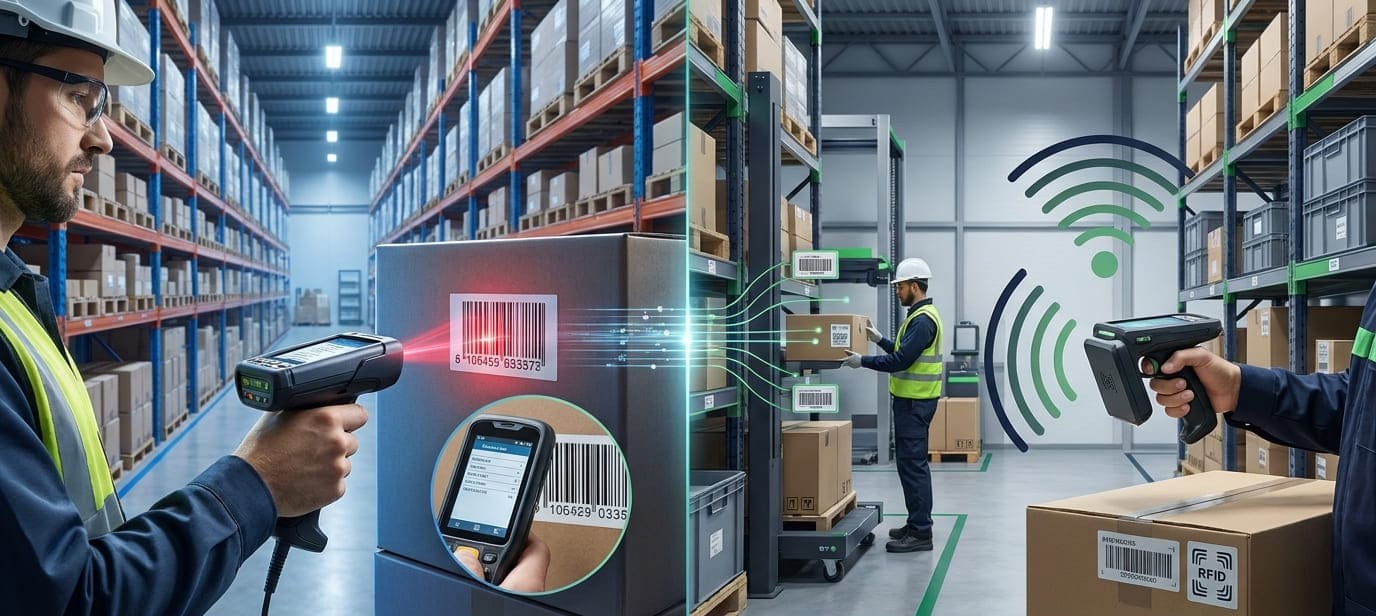
Choosing between barcode and RFID inventory tracking affects more than scanning speed. It determines how employees identify products, count stock, record movements, and investigate discrepancies. Barcodes offer inexpensive labels and straightforward workflows. Radio frequency identification (RFID) can read multiple tagged items without direct line of sight, but typically requires greater investment in hardware and setup.
The best choice depends on inventory volume, how often items move, labor costs, and the environment where scanning takes place. This guide compares barcode vs. RFID costs, benefits, accuracy, and practical use cases so businesses can select technology that fits their operations.
What Is the Difference Between Barcode and RFID?
A barcode is a printed, machine-readable symbol that encodes an item identifier. A camera or optical scanner captures the code, then inventory software uses it to retrieve or update a record. One-dimensional barcodes, QR codes, and Data Matrix codes can all support inventory identification.
RFID uses radio waves to communicate with electronic tags attached to products, equipment, or containers. An RFID reader captures a tag's identifier and passes it to a connected inventory management system. With suitable passive UHF equipment, multiple tags can be detected in one reading session, even when their labels are not directly visible.
Neither technology automatically creates accurate stock records. Receiving, picking, transfers, and counts still need correctly configured transaction rules.
How Barcode and RFID Inventory Tracking Work
Barcode workflow: Print or attach a barcode label, scan it when an item is received or moved, and update the related SKU or serialized item record. Optical visibility is generally required, so workers deliberately present each code to a handheld scanner or phone camera.
RFID workflow: Attach an RFID tag, configure a compatible reader and antenna, and associate the tag identifier with an inventory record. A handheld or fixed reader detects eligible tags in its read zone. Software filters duplicate or unintended reads before recording a valid event.
Passive RFID tags draw energy from the reader signal. Active RFID tags contain their own battery and serve different, often higher-value tracking needs. NFC is a short-range form of high-frequency RFID; it should not be confused with long-range, bulk-reading UHF RFID.
Barcode vs. RFID: Key Differences
RFID's longer potential read range does not mean that it provides precise real-time location by default. Reliable location visibility requires appropriate reader coverage, event processing, and sometimes additional technologies.
Barcode vs. RFID Cost Comparison
Barcode costs usually include printed labels, a phone or scanner, label printers when needed, software, and the labor involved in scanning. Existing smartphones can reduce upfront hardware spending, although labels may need replacement in harsh environments.
RFID costs include tags or smart labels, handheld or fixed readers, antennas, installation, middleware, software integration, testing, and training. Metal-mounted items or liquids may require specialized tags and careful placement. Active tags add battery and replacement considerations.
The relevant measure is total cost of ownership (TCO), not simply the price of a label or tag. A system with higher upfront costs may be economical if it reduces repeated cycle-counting labor. Conversely, RFID may offer little financial advantage where staff scan a modest number of items only occasionally.
Calculating RFID Return on Investment
Consider a hypothetical warehouse that spends 30 employee-hours weekly counting inventory by barcode. After a successful RFID pilot, the same task requires 10 hours. At a loaded labor cost of $20 per hour, the estimated labor saving is $400 weekly, or $20,800 over 52 weeks.
Compare that benefit against incremental tag purchases, reader infrastructure, integration, support, and ongoing expenses. A simplified calculation is ROI = (benefits − costs) ÷ costs × 100. These figures are illustrative, not promised performance results. Measure actual reading accuracy and staff time before investing.
Benefits and Limitations of Each Technology
Barcode benefits: Low-cost labels, familiar scanning processes, widespread compatibility, straightforward implementation, and deliberate verification of individual items. Barcode tracking suits businesses that need affordable control without complex infrastructure.
Barcode limitations: Labels must be optically accessible and readable. Staff may spend considerable time scanning products individually during large physical counts. Dirty, scratched, or hidden codes can interrupt workflows.
RFID benefits: Suitable systems can capture many identifiers quickly, reduce repetitive manual scanning, and support faster warehouse cycle counts. Fixed readers may capture movements at designed checkpoints.
RFID limitations: Tags and infrastructure cost more. Metal, liquids, tag orientation, interference, and unintended nearby reads can affect performance. RFID is not inherently more accurate; well-designed workflows and validation determine the quality of inventory records.
Best Use Cases for Barcode and RFID Inventory Tracking
Small retail stores and ecommerce fulfillment: Barcodes are often sufficient for receiving, picking, packing, and shipment verification. A barcode inventory system makes it possible to identify products and update quantities with familiar scanning tools.
Large apparel stores and distribution centers: Passive UHF RFID may justify its investment where teams repeatedly count thousands of tagged products or need high-volume identification without handling every item.
Manufacturing and spare parts: Barcodes can confirm components at workstations and document movements. RFID can assist with high-volume containers or production flows when tags and materials are compatible. Explore manufacturing inventory management for related operational workflows.
Tools and reusable equipment: Both methods support asset tracking. Barcodes work well for deliberate check-in and check-out; RFID can help with frequent equipment counts or controlled doorway reads.
Multiple warehouses: Either technology needs reliable location records. Consistent multi-location inventory tracking is essential when items move between sites.
Can You Use Barcode and RFID Together?
Yes. A hybrid inventory tracking system can use RFID for bulk stocktaking and barcodes for order confirmation, exceptions, or items where radio reads are unreliable. Both identifiers should connect to the same underlying product or asset record to avoid duplicate inventory.
For example, a warehouse might perform weekly RFID cycle counts but require a barcode scan at packing to verify the exact item shipped. The technologies serve different tasks instead of competing for every transaction.
How to Choose and Implement the Right System
Start with the workflow, not the hardware. Record how many items staff scan, how often they count stock, where mistakes occur, and how much time each task takes. Then:
Define the objective: Faster counts, better traceability, fewer picking errors, or reduced labor.
Assess the environment: Check metal shelving, liquids, packaging, lighting, and tag accessibility.
Estimate lifetime costs: Include tags, labels, hardware, software, training, and maintenance.
Run a small pilot: Measure missed reads, unintended reads, count time, and reconciliation effort.
Integrate records: Link scanned identifiers to receiving, transfers, adjustments, and shipping transactions.
Train and audit: Establish scan procedures and periodically compare physical inventory with digital records.
Many businesses can begin with mobile inventory tracking, then adopt additional identification methods as their operational requirements become clearer.
How GearChain Fits into Inventory Tracking
GearChain supports mobile barcode and QR code scanning, customizable inventory records, and spreadsheet synchronization. Its published features also describe NFC/RFID tag reading for asset and inventory workflows. Businesses can explore its barcode and RFID scanner and inventory management software to evaluate supported processes.
For NFC-based asset identification, users bring a compatible phone close to the tag. That should not be mistaken for automatic warehouse-scale passive UHF bulk scanning; verify reader compatibility and the exact workflow before deployment.
Conclusion
Barcodes usually make sense when budgets are tight and workers can scan items deliberately. RFID becomes attractive when high-volume counting, repeated movements, and reduced manual effort can offset higher costs. For many businesses, the strongest solution combines both technologies with accurate inventory records and tested workflows.
Frequently Asked Questions
What is the difference between RFID and barcode?
Barcodes use printed symbols read by an optical scanner, usually with a clear line of sight. RFID uses radio signals to detect electronic tags without direct optical visibility. Suitable RFID systems can read multiple tags together, while barcodes typically require deliberate scans.
Is RFID better than barcode for inventory tracking?
RFID is not always better. It can speed up high-volume counts and reduce individual scanning, but tags, readers, and integration cost more. Barcodes often suit smaller operations, controlled picking, and tight budgets. The right choice depends on measured workflow needs.
How much does RFID inventory tracking cost?
RFID costs depend on tag type, quantity, readers, antennas, software integration, installation, and maintenance. Passive tags generally cost more than printed barcode labels. Calculate total ownership costs and compare expected labor savings rather than relying on a single per-tag price.
Does RFID require line of sight?
No. RFID readers can detect compatible tags using radio waves without a direct optical view. However, range and read reliability depend on frequency, tag design, placement, and nearby materials. Metal and liquids can interfere, so real-world testing remains essential.
Is RFID more accurate than barcode scanning?
Neither technology guarantees accurate inventory. RFID can reduce missed manual scans during large counts, but unintended reads and interference create other risks. Barcodes provide deliberate confirmation, yet labels can be damaged. Accuracy depends on setup, procedures, and record validation.
Can RFID and barcodes be used together?
Yes. Businesses can use RFID for fast bulk counting and barcodes for picking, packing, or exception checks. Connecting both identifiers to the same inventory record helps avoid duplicates and preserves a consistent transaction history across warehouse workflows.