Managing Antique Inventory: Unique Challenges and Solutions
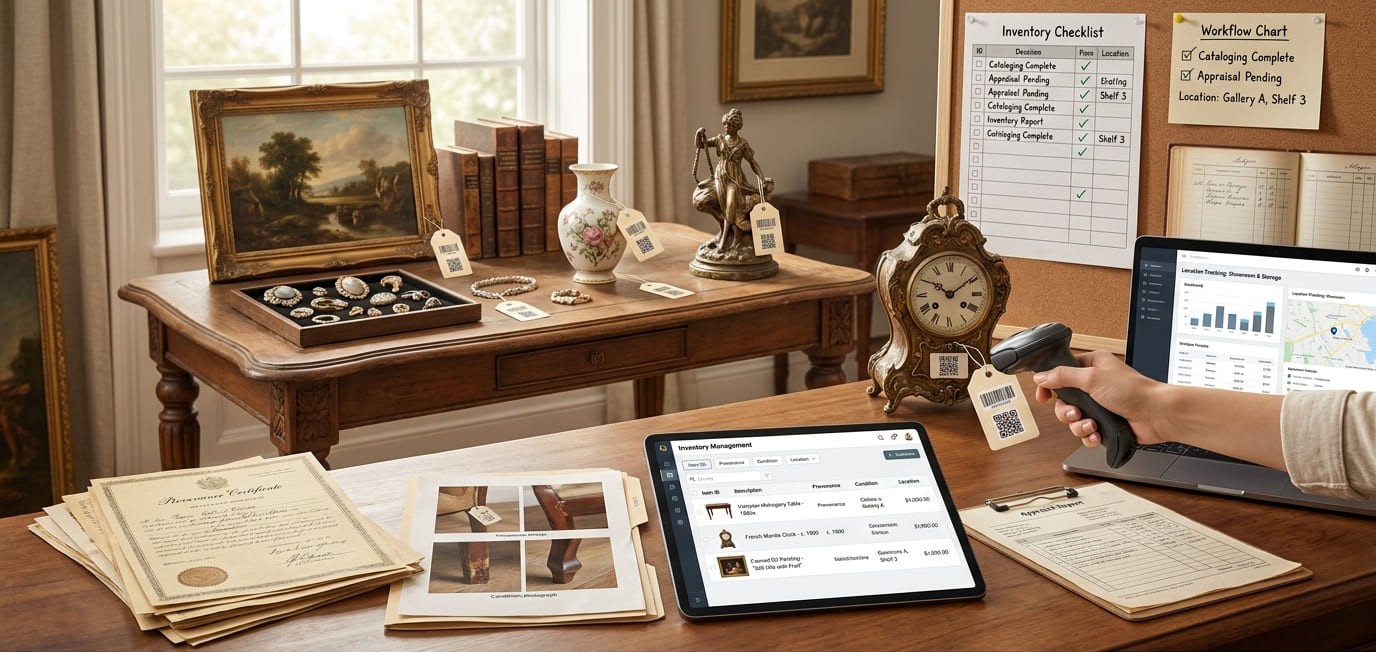
Antique inventory management is more complex than tracking ordinary retail stock. Every piece may be unique, difficult to replace, and affected by provenance, condition, restoration history, rarity, and market demand. A reliable inventory system therefore needs to do more than count products. It should document each object, connect it to its history, track its location, record financial value, and preserve information needed for sales, appraisals, insurance, and future research.
For antique dealers, vintage resellers, collectors, estate-sale professionals, and antique mall vendors, the best approach is to treat each piece as an individual asset. A structured digital inventory supported by photographs, unique item IDs, barcode or QR code tracking, and consistent records creates a clearer view of the collection from acquisition to sale. Current antique inventory systems similarly emphasize item-level records covering photographs, provenance, costs, location, condition, and sales history.
Why Antique Inventory Management Is Different
Traditional retail inventory is usually built around repeatable SKUs. Antiques do not behave that way. A Victorian table, signed painting, vintage clock, or rare ceramic piece may be completely different from every other item in stock.
That means the business must identify each item accurately, record acquisition details, preserve provenance documents, evaluate condition, monitor restoration, determine an asking price, and track the physical location of the piece. When those details live in notebooks, photo folders, receipts, and separate spreadsheets, important information can easily become disconnected.
A strong antique inventory management system creates one record for each piece and keeps its commercial and historical information together.
Challenge 1: Cataloging One-of-a-Kind Items
Antique cataloging begins with detailed identification. Instead of recording only a product name and quantity, create a unique item record containing an inventory number or SKU, category, maker, artist or manufacturer, era, origin, materials, dimensions, identifying marks, description, acquisition source, purchase price, and photographs.
Custom fields are useful because different categories need different information. Furniture may require dimensions and wood type, jewelry may require metal, gemstone, and hallmark details, while paintings may need artist attribution, medium, frame information, and signature notes.
Consistent cataloging also makes an antique inventory database easier to search by category, period, condition, price, location, or status.
Challenge 2: Tracking Provenance and Authenticity
Provenance can influence both historical significance and market value. Ownership history, auction records, old labels, receipts, certificates of authenticity, photographs, and appraisal documents may all contribute to an item's story.
Provenance tracking should therefore be part of the inventory record rather than stored separately. Record what is known, identify gaps, and attach supporting documentation when possible. Authentication notes, maker's marks, signatures, serial numbers, inscriptions, and other identifying features should also be photographed.
A well-documented history is especially useful when an antique changes hands, goes on consignment, moves between locations, or is reappraised later.
Challenge 3: Condition, Damage, and Restoration
Condition changes over time. Antiques can develop scratches, fading, cracks, loose joints, corrosion, or other deterioration. Restoration can also affect valuation depending on the object and the work performed.
Create a condition report when an item enters inventory and update it when something changes. Include photographs of damage, repairs, and restored areas. Record the date, cost, and nature of restoration work.
This gives buyers, appraisers, insurers, and staff a clearer history and reduces confusion when similar objects are stored together.
Challenge 4: Valuation and Pricing
Antique inventory valuation is more complicated than applying a standard markup. Purchase cost is only one factor. Dealers may also consider restoration costs, auction fees, transport, commission, comparable sales, rarity, provenance, condition, and current demand.
Useful records include acquisition cost, cost basis, appraised value, insured value, asking price, markdown history, selling price, and sale date. Keeping historical valuations is important because market conditions change.
For commercial inventory, tracking profit margin, days held, inventory aging, and sell-through rate can reveal which categories perform well and which become slow-moving inventory.
Challenge 5: Tracking Location and Movement
Antiques may move between showrooms, booths, warehouses, exhibitions, storage areas, auctions, and consignment locations. Each item should have a current location and, where useful, a movement history.
For multi-location antique businesses, centralized inventory helps staff see whether an object is in the shop, in storage, on loan, at an event, or already sold. Accurate location records also support inventory audits, insurance documentation, and loss prevention.
Use Barcodes and QR Codes for Faster Tracking
Many antiques arrive without manufacturer barcodes, but dealers can create internal identifiers. A barcode or QR code can connect the physical object to its digital inventory record.
The code does not need to contain every detail. Its purpose is to open the correct record quickly so staff can view photos, provenance, condition, value, location, and sales status. Scanning can also support receiving, transfers, stock counts, check-in, check-out, and sale updates. Barcode and QR workflows commonly use the code as an identifier linking a physical item to a more detailed digital record.
For fragile or historically significant pieces, place the code on a removable tag, protective sleeve, storage container, or nearby shelf rather than directly on the object.
Move Beyond Disconnected Spreadsheets
An antique inventory spreadsheet may work for a small collection, but complexity grows with more items, users, and locations. Common problems include inconsistent descriptions, duplicate records, outdated locations, missing photographs, and uncertainty about which version is current.
A modern inventory system can preserve familiar spreadsheet workflows while adding mobile data capture, structured forms, photos, scanning, real-time updates, and team access.
GearChain supports customizable no-code inventory and asset-tracking workflows, mobile barcode and QR scanning, label printing, photos, custom fields, multiple locations, team collaboration, and synchronization with Google Sheets and Excel. Those capabilities can be adapted to antique inventory, where each object needs an individual record rather than a simple quantity count.
What Should an Antique Inventory Record Include?
A practical record should capture:
Unique inventory ID or SKU
Item name and detailed description
Category, period, style, and origin
Maker, artist, manufacturer, or attribution
Materials, dimensions, and identifying marks
Acquisition date, source, and purchase price
Provenance and ownership history
Condition report and restoration history
Multiple photographs
Current location
Appraised, insured, and asking values
Consignor details when applicable
Sale status, selling price, and sale date
Supporting documents and certificates
Every field should help identify, protect, locate, value, sell, or document the item.
Build a Repeatable Antique Inventory Workflow
The most effective system is one staff can follow consistently. At acquisition, assign an ID, photograph the piece, record its source and cost, document condition, and add provenance. Next, tag the item and assign its location. Update the record whenever it moves, receives restoration, is repriced, goes on consignment, or is sold.
Periodic inventory audits should compare physical objects with digital records. Review missing documentation, outdated valuations, location discrepancies, and inventory that has been held longer than expected.
With a consistent process, antique inventory management becomes more than stock control. It becomes a structured record of each object's identity, history, condition, value, location, and commercial lifecycle.
For businesses that want to replace manual tracking with a flexible digital workflow, GearChain provides a practical foundation for item-level records, scanning, photos, location tracking, and spreadsheet synchronization. This approach helps antique dealers and collectors maintain a more organized, searchable, and traceable inventory as their collection grows.
FAQs
How do you keep track of antique inventory?
Use a unique item ID for every antique and maintain a digital record with photos, purchase details, provenance, condition, value, location, and sales status. Barcode or QR code labels can make stock counts, transfers, and item lookups faster and more accurate.
What information should be included in an antique inventory?
An antique inventory should include the item name, unique ID, description, maker, era, origin, materials, dimensions, acquisition date, purchase price, provenance, condition, restoration history, photographs, current location, appraised value, asking price, insurance information, and eventual sale details.
What is the best way to catalog an antique collection?
Catalog each object individually using a consistent digital template. Assign a unique inventory number, photograph the item from several angles, record identifying marks and provenance, document condition and value, and update the record whenever the antique moves, is restored, revalued, or sold.
How do you value antique inventory?
Antique valuation considers more than purchase cost. Dealers typically review condition, rarity, provenance, maker, age, authenticity, comparable sales, restoration, and current market demand. Keep the appraisal date and value type in the inventory record because market and insurance values can change.
Can you use barcodes or QR codes for antique inventory?
Yes. Dealers can assign internal barcodes or QR codes to individual antiques even when the objects have no manufacturer code. The label can link to a digital record containing photos, provenance, condition, value, location, and status without permanently marking the antique.
How do you track provenance for antiques?
Create a provenance section in each item's inventory record and document known owners, acquisition sources, auction references, receipts, certificates, labels, inscriptions, and supporting photographs. Clearly note any gaps or uncertain claims so future buyers, appraisers, and staff can distinguish documented history from assumptions.

Enter email to get Free Google Sheets Template
We’ll email you a quick verification link. Click it to confirm your address and your template will open automatically.
Enter email to get Free Excel Template
We’ll email you a quick verification link. Click it to confirm your address and your template will open automatically.