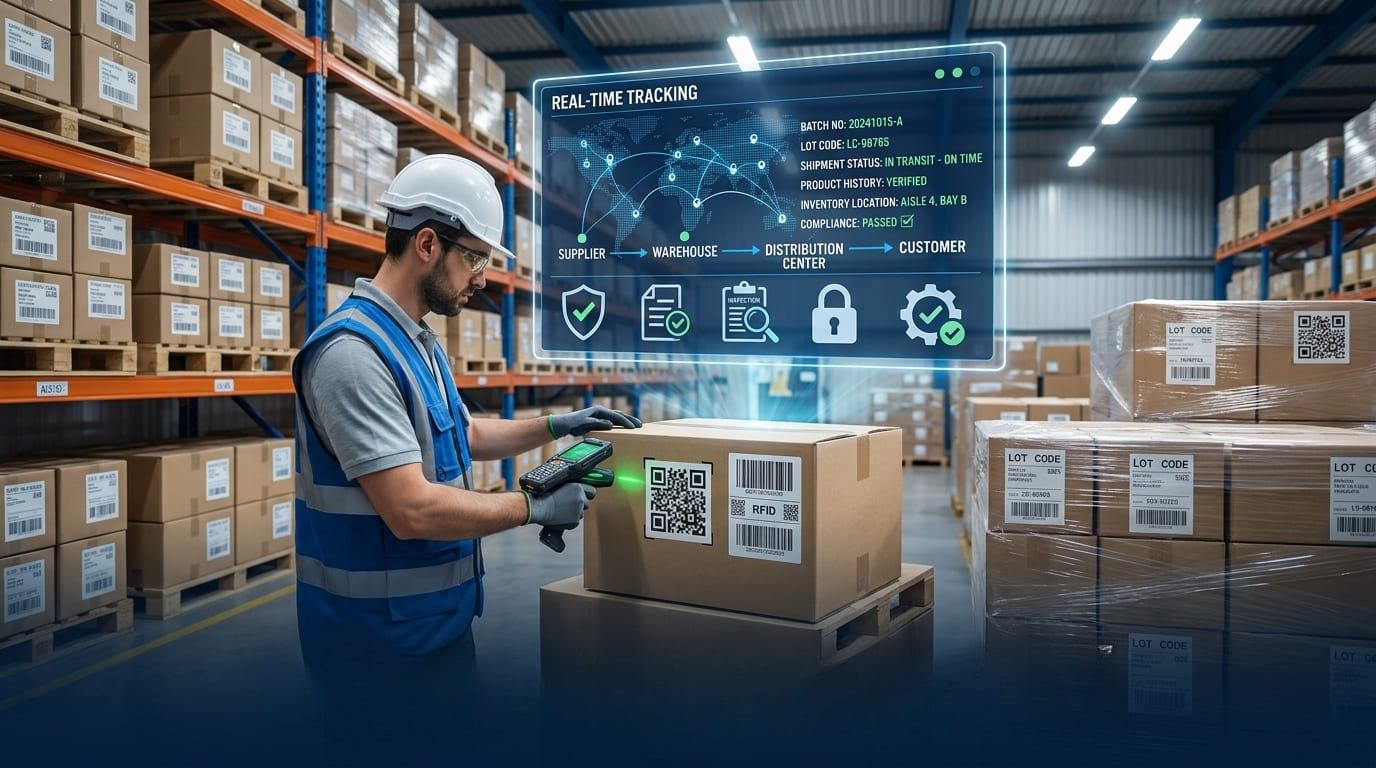
Product traceability identifies where a product came from, where it is now, where it has been, and what happened throughout its lifecycle. A track and trace system connects raw materials, batches, serial numbers, inspections, locations, shipments, and customers in one reliable record.
This visibility is essential when a defect, contamination event, counterfeit product, or compliance issue appears. Teams can identify affected stock, investigate the source, and document their response through structured data.
What Is Track and Trace?
Track shows an item’s current status or location. Trace reconstructs its history. Together, they create end-to-end product traceability from raw material receipt through production, storage, distribution, use, return, or disposal.
A traceability record may include a batch number, lot code, serial number, barcode, QR code, or NFC identifier, plus supplier information, production dates, inspections, locations, transfers, recipients, and corrective actions.
Forward traceability shows where a product was sent; backward traceability identifies its origin, components, and processing history.
How Product Traceability Improves Safety
Product safety depends on detecting problems early and preventing them from spreading. A digital product tracking system connects each item or batch with the information needed to assess its quality, authenticity, and condition.
Batch tracking can link finished goods to a supplier, production line, inspection result, and shipment. If a defect is found, the business can isolate the affected lot instead of treating all inventory as unsafe. Environmental records can also show whether sensitive goods were stored or transported outside acceptable limits.
Traceability supports defect detection, targeted quarantine, root cause analysis, authenticity verification, and corrective action.
For food organizations, the FDA Food Traceability Rule requires covered businesses to maintain Key Data Elements associated with Critical Tracking Events for foods on the Food Traceability List. These records support faster identification and removal of potentially contaminated food. The FDA states that enforcement will not begin before July 20, 2028.
Better Recall Management
A recall becomes more disruptive when a company cannot determine which units are affected. Incomplete records may force a broad withdrawal, delay customer notification, and make recall reconciliation difficult.
With lot traceability, serial number tracking, and distribution records, a company can quickly identify affected products, their locations, recipients, and the supplier, material, or process connected to the issue.
A strong recall traceability process supports rapid search, stock quarantine, customer notification, product withdrawal, and proof of completion. Its audit trail shows when the issue was detected, who responded, and which corrective actions were taken.
Mock recalls test record retrieval, data completeness, supplier responsiveness, and recall readiness.
How Track and Trace Supports Compliance
Compliance depends on maintaining the right evidence in a consistent, accessible form. Auditors, customers, regulators, and certification bodies may require proof of product origin, manufacturing controls, chain of custody, inspections, labeling, storage, distribution, and corrective action.
An effective compliance tracking system helps organizations maintain audit-ready records, standardize data capture, retrieve information by batch or destination, demonstrate forward and backward traceability, document non-conformance, verify supplier accountability, and preserve time-stamped event histories.
Digital product passports are also increasing the importance of structured lifecycle data. The EU’s Ecodesign for Sustainable Products Regulation establishes a framework for Digital Product Passports, with detailed requirements developed through product-specific rules. The European Commission describes a DPP as a digital identity card that can store relevant product information and strengthen legal compliance.
Technologies Used in Product Traceability
Technology choices depend on product value, operating conditions, regulatory risk, and tracking detail.
Barcodes and QR codes provide affordable machine-readable identification. Serial numbers support item-level tracking, while batch and lot codes group products produced under shared conditions. RFID and NFC enable rapid or contactless identification, while IoT sensors can capture temperature, humidity, location, or handling conditions.
The identifier alone is not the traceability system. Each scan should connect to data such as the user, time, location, quantity, transaction type, quality status, source, or destination. Integration with inventory, warehouse, quality, spreadsheet, and reporting systems helps prevent data silos.
Blockchain-backed records can add tamper-resistant verification for selected transactions, but they do not guarantee accurate input. Reliable traceability still requires validation rules, clear responsibilities, accurate data capture, and secure access controls.
Building an Effective Track and Trace Process
Begin by mapping the product journey from suppliers and raw materials to production, storage, distribution, returns, and disposal. Identify critical tracking events and the key data required at each stage.
Choose the right tracking level: item-level serialization, batch traceability, lot tracking, or a combination. Assign unique identifiers, define mandatory fields, establish scanning procedures, set permissions, and create record-retention rules.
Integrate the workflow with systems employees already use and capture data at the point of activity. Test it through audits and mock recalls. Useful measures include scan accuracy, missing records, inventory accuracy, traceability coverage, record retrieval time, and recall response time.
How GearChain Supports Track and Trace
GearChain is a no-code platform for tracking inventory, products, assets, equipment, and supply chain events. Teams can create custom forms, scan 1D and 2D barcodes, use NFC, print labels, capture data on mobile or web, and synchronize records with Google Sheets or Excel. Optional blockchain-backed traceability can strengthen selected scan events and transactions.
Organizations can configure lot numbers, serial numbers, locations, handlers, quantities, inspections, timestamps, source details, and recipients. Real-time updates make product history easier to retrieve during audits, investigations, and recalls.
Technology alone does not certify compliance, so each organization should validate its workflow against applicable laws and industry requirements. However, a well-configured digital system can replace fragmented records with a clearer, more accountable traceability process.
Conclusion
Using track and trace to enhance product safety and compliance creates more than inventory visibility. It provides the evidence needed to identify risk, isolate affected products, investigate root causes, conduct targeted recalls, verify authenticity, and respond confidently during audits.
The strongest systems combine unique identifiers, accurate event data, forward and backward traceability, secure records, and consistent supply chain participation. Accessible, trustworthy product information helps businesses protect customers, reduce disruption, strengthen compliance readiness, and build confidence in their products.
FAQs
What is product traceability?
Product traceability is the ability to follow a product, batch, or component from its origin through production, storage, distribution, and final use. It records identifiers, locations, handlers, processes, and transactions so businesses can verify history, manage quality, and respond to safety issues.
How does a track and trace system work?
A track and trace system assigns a unique identifier to a product, batch, or asset. Each scan records events such as receipt, production, inspection, transfer, shipment, or return, creating a searchable history that supports inventory visibility, recalls, audits, and compliance.
How does track and trace improve product safety?
Track and trace improves product safety by linking products to suppliers, batches, inspections, locations, and customers. When a defect or contamination issue occurs, teams can quickly identify affected inventory, isolate it, investigate the cause, and prevent unsafe products from moving further.
How does product traceability help with recalls?
Product traceability helps with recalls by showing which batches or serial numbers are affected and where they were distributed. This enables targeted withdrawals, faster customer notification, accurate reconciliation, and documented corrective action while reducing the need to recall safe, unrelated inventory.
What is the difference between tracking and tracing?
Tracking identifies a product’s current location, status, or movement through the supply chain. Tracing reconstructs its previous history, including origin, materials, production events, handlers, and destinations. Used together, they provide forward and backward visibility for safety, quality, and compliance.
Which technologies are used for product traceability?
Common product traceability technologies include barcodes, QR codes, serial numbers, RFID, NFC, mobile scanners, IoT sensors, cloud databases, and system integrations. Some organizations also use blockchain-backed records to make selected transactions easier to verify and harder to alter unnoticed.