Customer Success Stories: Transforming Inventory Management with GearChain
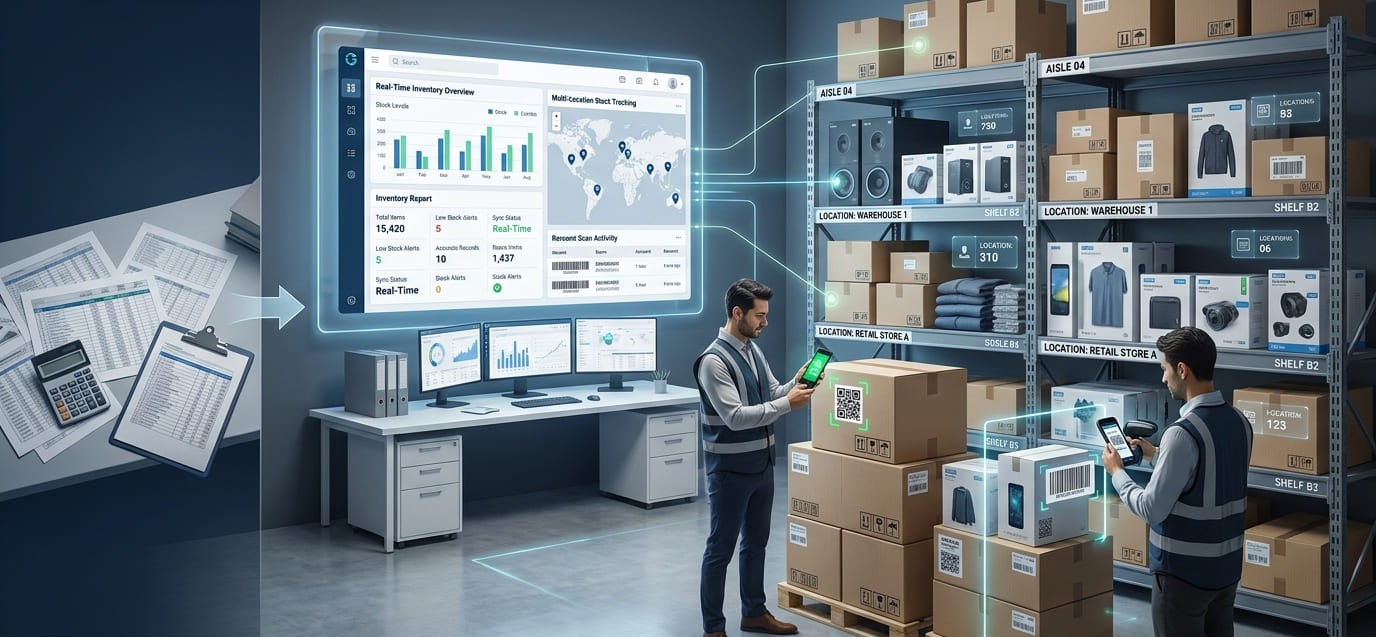
Inventory problems often begin when growing teams rely on manual stock counts, paper records, disconnected spreadsheets, and delayed updates. As products move across stores, warehouses, production areas, or field locations, small data gaps can become stockouts, excess inventory, fulfillment delays, and unreliable inventory records.
Modern inventory management software solves this by creating a more accurate, real-time view of stock movement. GearChain combines mobile barcode and QR scanning, no-code tracking workflows, spreadsheet synchronization, multi-user collaboration, real-time inventory visibility, and reporting. It currently supports Google Sheets, Excel, Google Drive, OneDrive, plus API connections to other business systems.
From Manual Inventory Tracking to Real-Time Control
Manual inventory tracking may work when a business is small. It becomes harder as SKU counts increase, more employees update records, and inventory spreads across locations. A stock count may be accurate today but outdated after tomorrow’s receipts, transfers, sales, or production use.
GearChain brings these activities into structured mobile workflows. Teams can scan items when they are received, moved, checked out, transferred, consumed, or counted. Instead of relying on someone to update a spreadsheet later, the stock movement becomes part of the inventory tracking process itself.
Customer Story: Faster Multi-Location Inventory Reconciliation
A published GearChain inventory management case study follows a cosmetic retail business with multiple stores. Previously, workers handled monthly shipments containing thousands of items using paper-based tracking. Barcode numbers and quantities were written manually, then office staff re-entered the information into Google Sheets. Reconciliation could take more than two days per store and still produce inventory inaccuracies.
The business introduced mobile barcode scanning connected to Google Sheets. Store employees scanned products on their phones, adjusted quantities during reconciliation, and sent updates to shared spreadsheets in real time. Office administrators could monitor changes without duplicating data entry.
GearChain reports that reconciliation averaged about two hours and eight minutes across the locations measured, representing an approximately 91.11% reduction in reconciliation time compared with the previous process. The calculation did not include additional administrative time saved by eliminating manual entry.
What Other Customers Value in Everyday Inventory Work
GearChain’s customer feedback also points to practical adoption benefits. An education user highlighted easy item check-in and check-out with a phone used as a barcode scanner, while a vending operator emphasized the platform’s user-friendly workflow and direct Google Sheets connection. These examples reinforce a common success pattern: inventory technology works best when frontline teams can use it without adding complicated hardware or unfamiliar processes.
Real-Time Inventory Visibility Across Locations
Multi-location inventory management requires more than a total stock count. Teams need to know where inventory is available and whether that information is current.
GearChain provides a centralized view of inventory across stores, stockrooms, and warehouses. Its retail workflows include barcode and QR scanning, low-stock alerts, custom reporting, multi-location visibility, and stock transfers. Users can filter stock by location, product, or category from mobile or desktop devices.
That visibility supports smarter inventory replenishment. When one location has surplus stock and another is running low, a transfer may avoid unnecessary purchasing. This can support stock level optimization, reduce overordering, and help protect working capital.
Improving Inventory Accuracy with Barcode Scanning
A barcode inventory system connects physical inventory movement with digital records. Instead of manually typing an SKU, quantity, or location, employees scan items as work happens.
GearChain supports 1D and 2D barcodes, QR codes, barcode label generation, mobile access, audit history, real-time synchronization, and multi-location inventory tracking. Existing product barcodes can also be used.
For warehouse management and stock control, barcode-driven workflows can reduce manual entry and support better receiving, cycle counting, inventory reconciliation, picking accuracy, and traceability. Fewer manual handoffs also mean fewer opportunities for human error.
Moving Beyond Spreadsheets Without Losing Familiar Workflows
Many businesses depend on Google Sheets or Excel for reports, formulas, purchasing, and operational data. Replacing those workflows overnight can create unnecessary resistance.
GearChain takes a bridge approach. It adds mobile scanning, custom forms, live updates, collaboration, and structured inventory records while continuing to synchronize with familiar spreadsheets. It can also connect to legacy systems and ERPs through APIs.
Supporting Inventory Optimization and Demand Planning
Reliable inventory data improves inventory forecasting and replenishment decisions. GearChain supports reporting, low-stock alerts, demand-planning workflows, and tracking across raw materials, components, work-in-progress inventory, finished goods, warehouse transfers, and multi-location stock movement.
That visibility helps teams manage reorder points, safety stock, excess inventory, slow-moving stock, and potential shortages.
Measuring Inventory Management Success
Successful inventory transformation should be measurable. Useful inventory KPIs include inventory accuracy, stockout rate, inventory turnover, order accuracy, fulfillment time, carrying cost, dead stock value, backorder rate, and cycle-count variance. GearChain’s inventory guidance highlights these types of metrics as important indicators of inventory performance.
These measures connect inventory operations to business outcomes such as better purchasing, faster fulfillment, improved cash flow, and customer satisfaction.
Building Scalable Inventory Operations
A scalable inventory management system should support frontline work and management visibility. GearChain combines no-code configuration, mobile scanning, spreadsheet integration, role-based access, reporting, AI-assisted setup, and optional blockchain-backed traceability. It supports multiple users, locations, projects, and workflows, and the company says more than 3,000 organizations use the platform worldwide.
The takeaway is simple: accurate capture, real-time visibility, consistent workflows, and actionable data help teams spend less time correcting records and more time improving replenishment, warehouse efficiency, order fulfillment, supply chain visibility, and customer service.
FAQs
1. What is inventory management?
Inventory management is the process of tracking, storing, controlling, and replenishing stock so the right items are available when needed. Effective inventory management improves inventory accuracy, reduces stockouts and excess inventory, supports order fulfillment, and helps businesses use working capital more efficiently.
2. What are the benefits of inventory management software?
Inventory management software gives businesses real-time stock visibility, reduces manual data entry, improves inventory accuracy, and supports faster replenishment and order fulfillment. It can also centralize multi-location inventory, automate alerts, strengthen reporting, and help teams make better purchasing and warehouse decisions.
3. How does inventory management software work?
Inventory management software records stock receipts, movements, transfers, counts, and usage in a centralized system. Barcode scanning, mobile updates, alerts, integrations, and reporting keep inventory data current, helping teams track stock levels, find items, replenish inventory, and reduce manual errors.
4. How can I improve inventory accuracy?
Improve inventory accuracy by recording every stock movement when it happens, using barcode or QR scanning, standardizing item data, running regular cycle counts, investigating discrepancies, and keeping one reliable inventory record synchronized across employees, warehouses, stores, and other operating locations.
5. How can inventory management software reduce stockouts?
Inventory management software can reduce stockouts by showing current stock levels, monitoring inventory movement, setting minimum-stock or reorder alerts, and improving replenishment timing. Better demand forecasting and multi-location visibility also help teams identify shortages early and redistribute available stock before ordering more.
6. How do you track inventory across multiple locations?
Track multi-location inventory with one centralized system that records stock separately for each store, warehouse, stockroom, or site. Use barcode scanning for transfers, real-time synchronization for inventory updates, and location-level alerts and reports to maintain accurate visibility across the entire operation.

Enter email to get Free Google Sheets Template
We’ll email you a quick verification link. Click it to confirm your address and your template will open automatically.
Enter email to get Free Excel Template
We’ll email you a quick verification link. Click it to confirm your address and your template will open automatically.