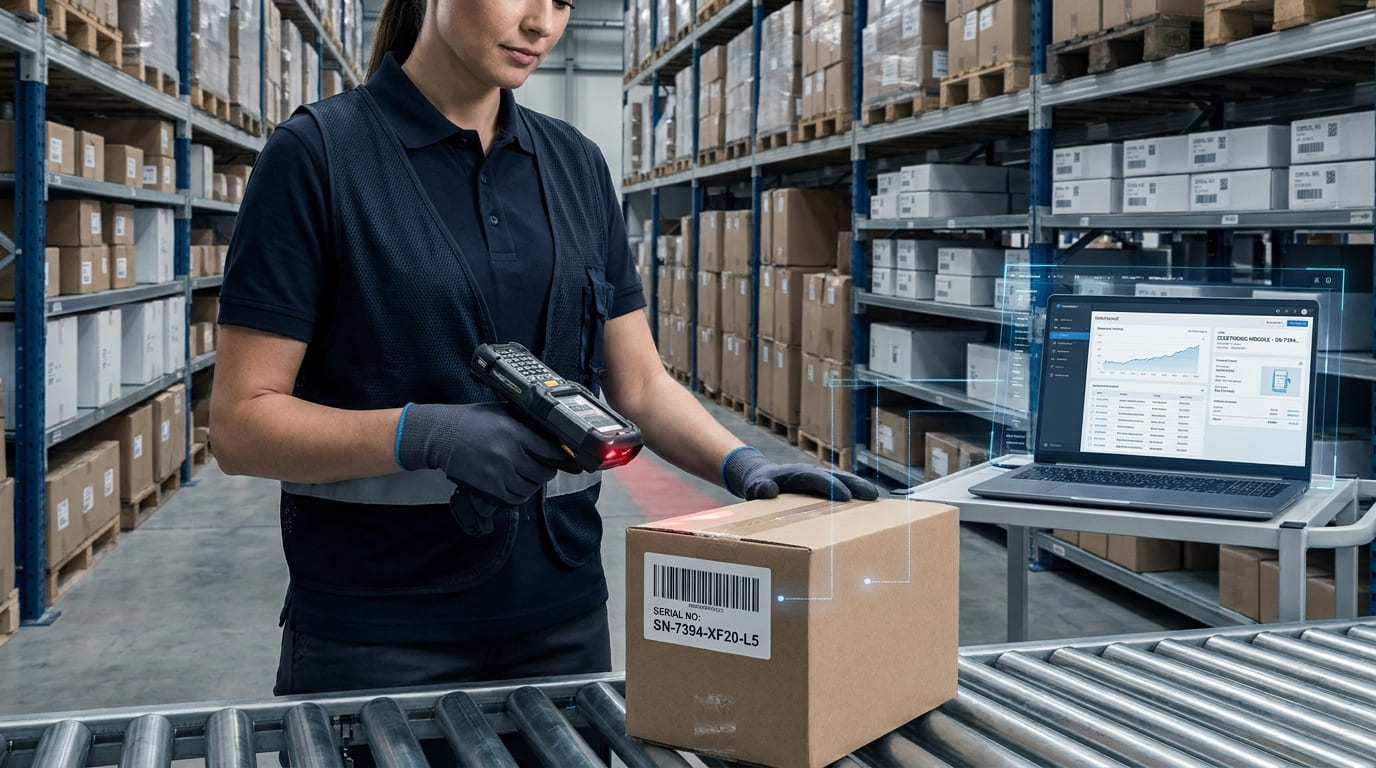
Every product in your inventory may look identical, but that does not mean every unit should be treated the same. When a business needs to identify a specific product, check its history, verify its warranty, or trace where it went, ordinary quantity-based inventory tracking may not be enough. This is where serial number tracking becomes important.
Serial number tracking helps businesses identify and monitor individual products throughout their lifecycle. From receiving and storage to shipping, returns, and repairs, it creates a record of what happened to each specific unit. Understanding how it works can help businesses improve inventory accuracy, product traceability, and operational accountability.
What Is Serial Number Tracking?
Serial number tracking is the process of assigning, recording, and monitoring a unique identifier for an individual product or asset. Unlike a general product code shared by multiple units, a serial number distinguishes one specific item from another.
For example, a retailer might have 50 identical laptops with the same product model and SKU. However, each laptop has a different serial number. This allows the retailer to identify exactly which unit was sold, returned, repaired, or transferred.
In serialized inventory management, businesses maintain individual item records instead of relying exclusively on total stock quantities. These records can contain serial numbers, product descriptions, locations, purchase details, ownership information, and transaction history.
How Does Serial Number Tracking Work?
A serial number tracking process follows individual products through important inventory activities. Each transaction updates the item's record, helping businesses maintain a reliable history.
1. Assign or Capture Serial Numbers
Manufacturers generally assign serial numbers during production. Businesses receiving finished products can capture the existing identifiers rather than creating new ones. For items without serial numbers, an organization may assign its own unique internal identifiers where appropriate.
2. Record Products During Receiving
When inventory arrives, employees scan or manually enter each serial number into the inventory system. The record can be associated with the supplier, purchase order, receiving date, and storage location.
Accurate receiving records establish the starting point for product traceability.
3. Track Storage and Inventory Movements
As products move between warehouses, shelves, departments, or business locations, their records should reflect the changes.
This helps employees locate specific units rather than simply checking how many products are available. It also creates a transaction history for inventory transfers and adjustments.
4. Link Serial Numbers to Sales and Shipments
During order fulfillment, the business records which individual unit is being shipped. Connecting the serial number with the sales order and customer information makes it easier to verify the exact product delivered.
5. Manage Returns, Repairs, and Warranties
When a product comes back, employees can search its serial number to retrieve its available purchase and service history. This helps verify the returned unit, investigate warranty eligibility, and document repairs or replacements.
A complete process connects the product's identity with its important inventory events.
Serial Number vs. SKU vs. Lot Number: What's the Difference?
These identifiers serve different purposes, and confusing them can create inventory tracking problems.
A SKU helps businesses organize products and manage stock quantities. A lot number groups products manufactured or received together. A serial number identifies one specific unit.
Barcode and QR code labels can encode serial numbers, SKUs, or other identifiers, allowing employees to retrieve the corresponding records through scanning.
Businesses can use SKU, lot, and serial number tracking together when their operations require both batch-level and individual-unit traceability.
For more information, explore this guide to SKU and MOQ inventory basics.
When Do You Need Serial Number Tracking?
Serial number tracking is particularly useful when individual products have different histories, ownership records, warranty conditions, or maintenance requirements.
Common situations include:
Electronics: Laptops, smartphones, cameras, and other devices often require individual identification for warranty verification and returns.
Medical equipment: Healthcare organizations may need to identify specific devices and maintain maintenance, inspection, and service records.
Industrial machinery: Businesses can track individual machines, replacement components, repair history, and maintenance schedules.
High-value inventory: Expensive products benefit from unit-level identification because losing or misplacing one item can have significant financial consequences.
Manufacturing: Manufacturers can connect finished products with production records, quality checks, and relevant component information.
Retail and distribution: Businesses can identify the exact unit shipped to a customer and verify returned products.
Serial number tracking is especially valuable when a business needs to answer questions such as: Which unit was shipped? Where is it now? Has it been repaired? Is it the same product that the customer originally purchased?
When Is Serial Number Tracking Unnecessary?
Not every product requires individual identification. Tracking every unit separately can introduce additional scanning, data entry, and administrative work without providing meaningful benefits.
For example, a business selling inexpensive office supplies, disposable packaging, or standard cleaning materials may only need quantity-based inventory tracking.
Lot tracking may also be sufficient when the main requirement is identifying groups of products manufactured or received together, such as food ingredients or materials from a particular production batch.
The decision should depend on product value, traceability requirements, warranty obligations, regulatory considerations, and the cost of maintaining individual records.
Key Benefits of Serial Number Tracking
1. Better inventory accuracy: Individual identification helps employees distinguish between identical products and locate specific units.
2. Improved product traceability: Businesses can maintain records of receiving, storage, transfers, sales, and other important product events.
3. Easier warranty management: Serial number records help retrieve purchase and service information when customers request warranty support.
4. More reliable returns processing: Employees can compare a returned product's serial number with the original sales record to identify mismatches and investigate potential return fraud.
5. Better recall management: When a manufacturer identifies an affected production group or specific units, recorded identifiers can help locate the relevant inventory.
6. Stronger accountability: Transaction records can show when an item was received, transferred, issued, or updated, along with relevant timestamps and user information.
How to Set Up a Serial Number Tracking System
An effective setup starts with a clear identification and recording process.
Identify products requiring serialization: Prioritize expensive equipment, warranty-sensitive products, and items requiring individual traceability.
Choose the identification method: Use existing manufacturer serial numbers or create unique internal identifiers where necessary.
Create inventory records: Record the serial number alongside product details, location, supplier, and other relevant information.
Introduce barcode scanning: Use barcode or QR code labels to reduce manual entry and make product identification easier.
Define tracking checkpoints: Decide when employees must capture serial numbers, such as receiving, transferring, shipping, and returns.
Maintain transaction history: Record important movements and updates so the product's history remains accessible.
Audit records regularly: Check physical products against digital records and investigate missing or duplicate identifiers.
Businesses can simplify these workflows using barcode inventory management and mobile inventory and asset management.
Common Serial Number Tracking Mistakes
Even a well-designed system can produce unreliable records if employees do not follow consistent procedures.
Common mistakes include:
Entering incorrect or duplicate serial numbers.
Shipping products without recording their individual identifiers.
Failing to update records after inventory transfers.
Confusing product SKUs with individual serial numbers.
Recording returns without verifying the original product.
Maintaining incomplete or outdated inventory histories.
To avoid these problems, establish clear scanning procedures, validate identifiers, restrict unnecessary record changes, and perform regular inventory reconciliation.
How GearChain Supports Digital Inventory Tracking
Businesses implementing serial number tracking need a practical way to capture identifiers and maintain consistent inventory records.
GearChain provides barcode and QR code scanning, customizable inventory forms, mobile inventory updates, and spreadsheet synchronization. Teams can configure item records to include the identifiers and additional fields their workflows require.
For example, businesses can use a barcode field to capture an existing product identifier and add custom fields for serial numbers, suppliers, locations, or other relevant details. The exact tracking workflow depends on how the inventory form is configured.
Its inventory management software supports stock receiving, issuing, transfers, and inventory history. Businesses can also explore track-and-trace workflows to manage item movements across locations.
The goal is to make inventory information easier to capture, update, and review without relying entirely on manual spreadsheets.
Frequently Asked Questions
What is serial number tracking?
Serial number tracking is a method of identifying and monitoring individual products using unique identifiers. It allows businesses to maintain unit-specific records covering receiving, storage, transfers, sales, repairs, and returns throughout a product's lifecycle.
How does serial number tracking work?
Businesses record each product's unique serial number in an inventory system. Employees capture the identifier during receiving, update records during transfers and sales, and retrieve its history when processing returns, repairs, or warranty claims.
What is the difference between a serial number and an SKU?
A serial number identifies one specific product unit, while an SKU identifies a product type or variant. Multiple identical products can share the same SKU, but each individually serialized unit has its own unique serial number.
When should a business use serial number tracking?
Businesses should use serial number tracking when individual products require warranty verification, maintenance histories, ownership records, recall identification, or detailed traceability. It is particularly useful for electronics, medical equipment, industrial machinery, and high-value inventory.
Can you track serial numbers with barcodes?
Yes. A barcode can encode a product's serial number, allowing employees to scan the label and retrieve its associated inventory record. The tracking system must also record relevant transactions to maintain a useful product history.
Is serial number tracking better than lot tracking?
Neither method is universally better. Serial tracking identifies individual units, while lot tracking identifies groups of products. Businesses should choose based on their traceability requirements, product characteristics, and operational needs.
Final takeaway
Serial number tracking is most valuable when knowing exactly which product you have matters more than knowing how many products are available. By combining unique identifiers, consistent scanning, and reliable inventory records, businesses can improve traceability, accountability, and product lifecycle management.