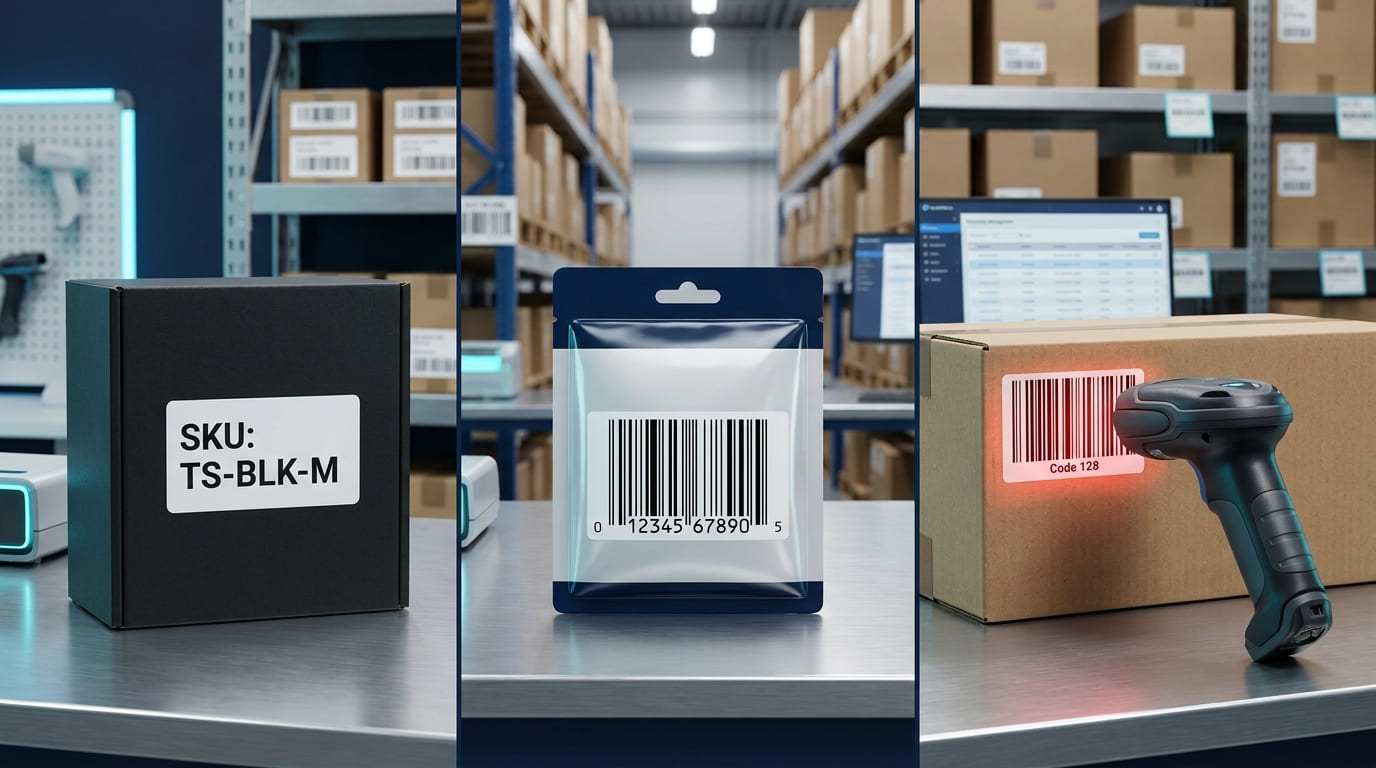
SKU, UPC, and barcode are often treated as the same thing, but they serve different purposes in product identification and inventory management.
A SKU (Stock Keeping Unit) is an internal code a business creates to identify and track its products or variants. A UPC (Universal Product Code) is a standardized 12-digit product identifier commonly used in North American retail. A barcode is the machine-readable symbol a scanner reads. It can carry a UPC, SKU, or another identifier.
In short:
SKU: identifies an item inside your business.
UPC: identifies a trade item across retail and sales channels.
Barcode: makes an identifier scannable.
Understanding the difference helps businesses organize product records, track inventory accurately, and choose the right identification method for warehouse, retail, and ecommerce workflows.
SKU vs. UPC vs. Barcode at a Glance
What Is a SKU?
SKU stands for Stock Keeping Unit. It is a unique internal identifier created by a business to organize and track inventory.
SKUs can contain letters, numbers, or both. A business may build useful product details into a SKU, such as category, color, size, style, or model. For example, a black medium T-shirt could use TS-BLK-M.
Another retailer selling the same shirt may use a completely different SKU because SKUs are business-specific.
Separate product variants should normally have separate SKUs when they need to be tracked independently. This makes it easier to monitor stock levels, sales, picking, replenishment, and reporting by variant.
GearChain’s guide to SKU basics explains how internal product codes support organized inventory records.
What Is a UPC?
UPC stands for Universal Product Code. In common retail use, UPC refers to the standardized 12-digit product identifier known as GTIN-12.
Unlike a SKU, a UPC is not simply a code created differently by each retailer. It is intended to identify a trade item consistently across retail and other sales channels.
That makes UPCs useful when products move between manufacturers, distributors, retailers, ecommerce sellers, and point-of-sale systems.
The same product may have different internal SKUs at different businesses while retaining the same standardized UPC. Businesses that sell through external channels can learn more about GTINs and UPC barcodes and standardized product identification.
What Is a Barcode?
A barcode is a machine-readable representation of data. A scanner or mobile device reads the symbol and sends the encoded value to an inventory, warehouse, or point-of-sale system.
A barcode is not automatically a UPC. A barcode can represent a UPC, SKU, serial number, location code, or another identifier.
For example, a business can encode an alphanumeric SKU in a Code 128 barcode. When an employee uses a barcode scanner, the system can match the scanned value with the correct product record.
This distinction is important: the identifier tells the system which item it is, while the barcode provides a fast way to capture that identifier.
What Is the Difference Between SKU and UPC?
The main difference between a SKU and UPC is how the identifier is created and where it is used.
A SKU is created internally. The business decides its structure and may use it for product variants, purchasing, stock counts, picking, and reporting.
A UPC is standardized for broader trade-item identification. It is useful when the same product needs to be recognized across retailers, distributors, and sales systems.
The easiest way to remember it is:
SKU = internal identification
UPC = standardized product identification
Many businesses use both. The SKU supports internal inventory organization, while the UPC supports external product recognition.
What Is the Difference Between SKU and Barcode?
A SKU is an identifier. A barcode is a scannable representation of data.
For example, SHOE-BLK-10 may be an internal SKU. That value can be encoded into a Code 128 barcode and printed on a label. Scanning the label retrieves the SKU without requiring an employee to type it manually.
So you do not always choose between a SKU and a barcode. They can work together.
Businesses that need labels for internal inventory can create barcode labels that connect physical items with digital product records.
What Is the Difference Between UPC and Barcode?
A UPC is the product identifier; a barcode is the machine-readable symbol used to carry an identifier.
A 12-digit UPC is commonly represented in a UPC-A barcode. When the symbol is scanned, a system reads the number and looks up the related product record.
This also explains why not every barcode is a UPC barcode. Warehouses and businesses use other barcode formats for SKUs, parts, locations, assets, and internal inventory workflows.
Can One Product Have Both a SKU and UPC?
Yes. A single product can have both because the two identifiers serve different purposes.
A retailer might create its own SKU to fit an internal naming convention while also storing the product’s UPC for retail scanning and standardized identification.
Product variants matter as well. Different sizes, colors, pack quantities, or configurations that are tracked or sold separately generally need separate records and appropriate identifiers.
Which One Do You Need?
Use a SKU when you need an internal code for products, supplies, materials, or variants.
Use a UPC when a product needs standardized identification for retail or other external sales channels that require a GTIN.
Use a barcode when you want to scan an identifier instead of entering it manually.
Many inventory operations use all three. A barcode inventory system can connect scanned identifiers to stock records so teams can update quantities and inventory movements faster.
How SKUs, UPCs, and Barcodes Work Together
Imagine a product arriving at a warehouse. It may already carry a manufacturer UPC. The receiving team scans the barcode and matches the product with an inventory record. Internally, the company may also use its own SKU for reporting and stock organization.
If an item does not have a suitable barcode, the business can create one that encodes its SKU or another internal identifier.
Scanning can then support:
receiving inventory
stock counts and cycle counts
picking and packing
stock transfers
product lookup
quantity updates
replenishment
reducing manual data entry
GearChain’s inventory management software connects barcode scanning with digital inventory records, helping teams track stock as it moves through daily operations.
Common SKU, UPC, and Barcode Mistakes
A common mistake is treating all three terms as interchangeable. That creates confusion when products are set up across inventory, retail, and warehouse systems.
Other mistakes include using one SKU for several variants, assuming every barcode contains a UPC, creating inconsistent SKU naming rules, or failing to connect scanned codes to the correct product record.
A clear identification structure improves inventory accuracy because employees can consistently identify, scan, count, move, and replenish the right item.
Final Takeaway
The difference between SKU vs. UPC vs. barcode becomes simple when you separate product identification from scanning.
A SKU is an internal identifier for an item or variant. A UPC is a standardized 12-digit product identifier used widely in retail. A barcode is the machine-readable symbol that carries an identifier for scanning.
They are not competing systems. They often work together to connect physical products with accurate digital inventory records.
FAQs
What is the difference between SKU, UPC, and barcode?
A SKU is an internal code a business creates to track products, while a UPC is a standardized 12-digit product identifier. A barcode is the machine-readable symbol that carries data, which can represent a UPC, SKU, or another identifier.
Is a SKU the same as a UPC?
No. A SKU is a business-specific identifier used for internal inventory management, while a UPC is a standardized product identifier used across retailers and sales channels. Different businesses may assign different SKUs to the same product, while its UPC remains consistent.
Is a SKU the same as a barcode?
No. A SKU is an identifier used to distinguish an item or product variant inside a business. A barcode is a machine-readable symbol. A company can encode its SKU into a barcode, but the SKU itself is not the barcode.
Can a product have both a SKU and UPC?
Yes. A product can have both a SKU and a UPC because they serve different purposes. The SKU supports internal inventory tracking, while the UPC provides standardized product identification that retailers, distributors, marketplaces, and point-of-sale systems can recognize.
Can you turn a SKU into a barcode?
Yes. You can encode a SKU into a barcode format such as Code 128, allowing employees to scan the SKU instead of typing it manually. This is useful for receiving, stock counts, picking, transfers, and other internal inventory workflows.
Does every product need a UPC?
No. Products used only for internal inventory tracking may not need a UPC. You typically need a UPC or other GTIN when products are sold through retailers, marketplaces, distributors, or other channels that require standardized product identification.