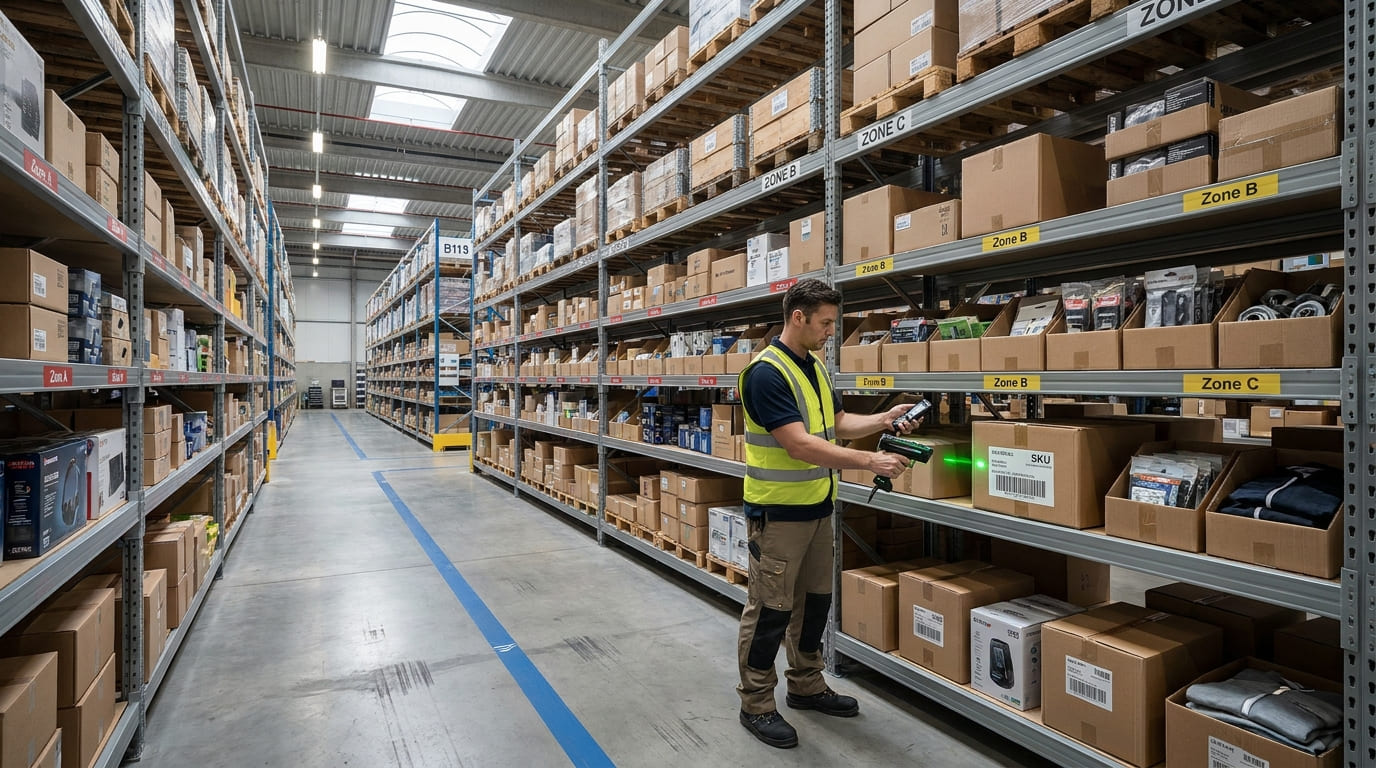
A warehouse can have accurate stock counts and still lose hours every day if inventory is stored in the wrong places.
When fast-moving SKUs sit at the back of the warehouse, frequently ordered products are spread across distant aisles, or heavy items are placed on awkward shelves, pickers spend more time walking, searching, bending, and handling than they need to.
Warehouse slotting solves this problem by assigning inventory to storage locations based on how products are actually picked, moved, stored, and replenished.
The goal is simple: organize inventory so the products your team needs most often are easier and faster to reach, without creating congestion or constant replenishment work.
For businesses already improving their inventory management, warehouse slotting is an important next step because accurate stock information becomes more valuable when every SKU also has a logical location.
What Is Warehouse Slotting?
Warehouse slotting is the process of deciding where each SKU should be stored inside a warehouse, stockroom, or distribution area.
A slot might be a bin, shelf, rack position, pallet location, or other defined storage location.
Good warehouse inventory slotting considers more than available space. It looks at factors such as pick frequency, SKU velocity, product size, weight, order history, product affinity, replenishment needs, and storage restrictions.
For example, a small product picked 60 times a day may deserve a more accessible location than a larger product that ships only twice a week.
The best slot is therefore not simply the nearest empty shelf. It is the location that supports faster, safer, and more efficient warehouse operations.
Why Warehouse Slotting Makes Picking Faster
Order picking requires employees to move from one storage location to another until every item in an order has been collected.
Poor product placement makes those routes unnecessarily long.
A fast-moving SKU at the far end of a warehouse forces employees to repeat the same long trip throughout the day. Moving that SKU into a more accessible pick location can shorten the pick path every time the product appears on an order.
Current warehouse-slotting guidance consistently treats picker travel as one of the main opportunities for improvement and recommends using pick activity, product characteristics, and location constraints together rather than slotting by available space alone.
Effective slotting can also support better picking accuracy because employees spend less time searching for products or moving between poorly organized locations.
Start With Pick Frequency, Not Just Sales
One of the most useful pieces of information for warehouse slotting is pick frequency.
Pick frequency tells you how often a picker has to visit a SKU's storage location.
This is different from the number of units sold.
Imagine Product A ships 100 units in one large order, while Product B ships one unit on 50 separate orders.
Product A represents more units, but it may require only one trip to its storage location. Product B may require 50.
For a warehouse trying to reduce picker travel distance, Product B may deserve the better location.
That is why order lines, picking history, and SKU activity can be more useful than revenue or total unit sales when planning warehouse product placement.
Accurate SKU records are equally important. Businesses that need a stronger foundation for product identification can review the basics of SKU management before reorganizing warehouse locations.
Use ABC Analysis to Prioritize Storage Locations
ABC analysis provides a practical starting point for velocity-based slotting.
A items are typically the products responsible for the highest share of picking activity. They should generally receive convenient, easily accessible storage positions.
B items have moderate activity and can use secondary locations.
C items move less frequently and can usually occupy storage areas that require slightly more travel.
The exact percentages do not need to be rigid. The purpose of ABC warehouse slotting is to identify which SKUs create the most picking work and give them appropriate storage priority.
Recent warehouse research has also demonstrated that combining ABC-style classification with picking workload analysis can reduce picking time and picking errors.
Consider Product Affinity
SKU velocity tells you how frequently an item moves. Product affinity tells you which items move together.
Review order history and look for products that frequently appear on the same order.
If two SKUs are regularly picked together but stored on opposite sides of the warehouse, every combined order creates unnecessary travel.
Moving related products into nearby locations can shorten picking routes and make multi-item orders easier to complete.
Affinity-based slotting should not override safety, storage requirements, or space constraints, but it adds important context that a simple fast-versus-slow classification can miss.
Use the Golden Zone Wisely
The most convenient shelf positions are often called the golden zone.
These are storage heights that allow a picker to retrieve inventory without excessive reaching, climbing, or bending.
High-frequency, manageable products are strong candidates for these locations.
However, SKU velocity should not be the only consideration. A heavy item may need to stay at a lower level for safer handling even if it moves frequently. Fragile, oversized, hazardous, or temperature-sensitive inventory may also require special storage.
Effective warehouse slotting therefore balances picking speed with product weight, dimensions, ergonomics, safety, and handling requirements.
Do Not Create a Congestion Problem
Moving every fast-moving SKU into the same aisle can create another problem: picker congestion.
If several employees repeatedly need the same small area, shorter theoretical travel distances may not result in faster picking.
Busy warehouse zones should therefore be balanced.
High-velocity inventory can sometimes be distributed across several accessible aisles rather than concentrated around one location. Product affinity, pick sequence, traffic flow, and the warehouse layout should all influence the final decision.
Research into warehouse re-slotting has found that congestion-aware placement can reduce both travel distance and waiting time during picking.
Match the Pick Face to Replenishment Demand
The pick face is the location from which employees normally retrieve an SKU during order fulfillment.
Behind that location may be reserve storage containing additional inventory.
A common warehouse slotting mistake is giving a high-velocity SKU an excellent location that is too small.
The product becomes easy to pick, but employees must constantly replenish the pick face from reserve stock.
That simply moves labor from picking to replenishment.
Pick-face sizing should therefore consider how quickly an item moves, how much inventory fits safely in the location, and how frequently the location will require replenishment.
Keep Storage Locations Accurate
A good slotting strategy depends on knowing exactly where inventory is located.
Moving Product A from Rack 12 to Rack 4 improves nothing if the inventory record still tells the picker to visit Rack 12.
Every re-slot should therefore be reflected in the inventory system immediately.
A barcode inventory system can make location updates easier by allowing teams to scan products as inventory is received, moved, picked, or transferred.
GearChain also allows businesses to record details such as bins, locations, suppliers, and part numbers while tracking stock movements across teams and locations.
For teams working throughout a warehouse rather than at a fixed computer, mobile inventory tracking can also help employees update item records closer to where inventory movement actually happens.
Review Slotting as Demand Changes
Warehouse slotting is not a one-time warehouse organization project.
SKU velocity changes.
A slow mover can become a bestseller. A seasonal product may generate heavy picking activity for three months and almost none afterward. Promotions, new product launches, discontinued inventory, and changing customer behavior can all affect the ideal storage location.
Warehouses should therefore review slotting periodically and also react when important demand changes occur.
Quarterly reviews can provide a useful baseline for many operations, while more dynamic environments may need to review high-impact SKUs more frequently. Current industry guidance generally recommends regular re-slotting rather than assuming the original warehouse layout will remain optimal indefinitely.
Historical movement data can also help teams identify which inventory deserves better warehouse space. Monitoring inventory turnover provides additional context around fast-moving and slow-moving stock.
Measure Whether Slotting Actually Improved Picking
After reorganizing inventory, compare warehouse performance before and after the changes.
Useful indicators include picking time, picker travel distance, picks per labor hour, order accuracy, replenishment frequency, congestion, and order cycle time.
If picking becomes faster but replenishment work increases dramatically, the new arrangement may need adjustment.
If fast-moving products are closer but employees now spend more time waiting in crowded aisles, those SKUs may need to be distributed differently.
Warehouse slotting optimization works best as a continuous improvement process rather than a one-time rearrangement.
How GearChain Supports Better Inventory Organization
Warehouse slotting depends on reliable information about SKUs, stock quantities, movements, bins, and storage locations.
GearChain supports day-to-day inventory tracking through barcode scanning, mobile access, customizable inventory fields, location records, stock transfers, low-stock alerts, and connected spreadsheet reporting.
Teams that still rely heavily on spreadsheets can also connect operational updates with spreadsheet sync, helping keep reporting connected to current inventory activity.
The objective is not to make warehouse slotting complicated. It is to make sure your team has accurate enough inventory and location data to decide where products belong and keep those records current when inventory moves.
Final Thoughts
Effective warehouse slotting starts with understanding how inventory actually moves.
Place frequently picked SKUs where they are easier to reach. Use ABC analysis and SKU velocity to identify high-activity products. Consider product affinity, size, weight, ergonomics, replenishment requirements, and aisle congestion before assigning the final storage location.
Most importantly, keep location records accurate and revisit the slotting strategy as demand changes.
A warehouse does not need more space simply because picking feels slow. Sometimes the biggest improvement comes from using the existing space more intelligently.
FAQs
What is warehouse slotting?
Warehouse slotting is the process of assigning inventory to specific bins, shelves, racks, or pallet locations based on pick frequency, product size, weight, demand, and handling needs. The goal is to reduce unnecessary travel and make order picking faster.
How do you organize inventory in a warehouse?
Organize warehouse inventory by reviewing SKU velocity, pick frequency, product dimensions, weight, storage requirements, and order history. Keep frequently picked items accessible, group compatible products when useful, separate problematic look-alike SKUs, and maintain accurate bin and location records.
How do you improve warehouse picking efficiency?
Improve warehouse picking efficiency by shortening pick paths, placing high-frequency SKUs in accessible locations, grouping products commonly picked together, keeping inventory locations accurate, reducing aisle congestion, and ensuring pick faces hold enough stock to avoid unnecessary replenishment trips.
What is ABC analysis in warehouse management?
ABC analysis groups inventory according to operational importance or activity. In warehouse slotting, A items generally represent high-frequency SKUs, B items move moderately, and C items move less often, helping teams prioritize the most accessible warehouse locations.
What is the golden zone in warehouse picking?
The golden zone is the easily reachable shelf area where pickers can retrieve products with less bending, stretching, or climbing. Frequently picked, safely handled items are often placed there to improve picking speed, ergonomics, and overall warehouse productivity.
How often should a warehouse be re-slotted?
Re-slotting frequency depends on demand changes, SKU mix, promotions, and seasonality. Many warehouses benefit from quarterly reviews, while high-volume operations may check important SKUs more frequently and relocate products when picking patterns or replenishment requirements change significantly.